Why a clam's local ENSO record cannot be relabelled as NOAA's relative index
The Jiigurru shell records one reef location. NOAA's relative index requires both equatorial Pacific and tropical-ocean temperature fields, making a shared threshold insufficient to convert the study's local event count.

The ten local ENSO-like episodes reconstructed from a giant-clam shell cannot simply be relabelled using NOAA's newer Relative Oceanic Niño Index. The obstacle is the information required by the index, rather than its name. The Jiigurru shell supplies a reconstruction for one northern Great Barrier Reef location; the relative index compares a specified equatorial Pacific region with the wider tropical ocean.
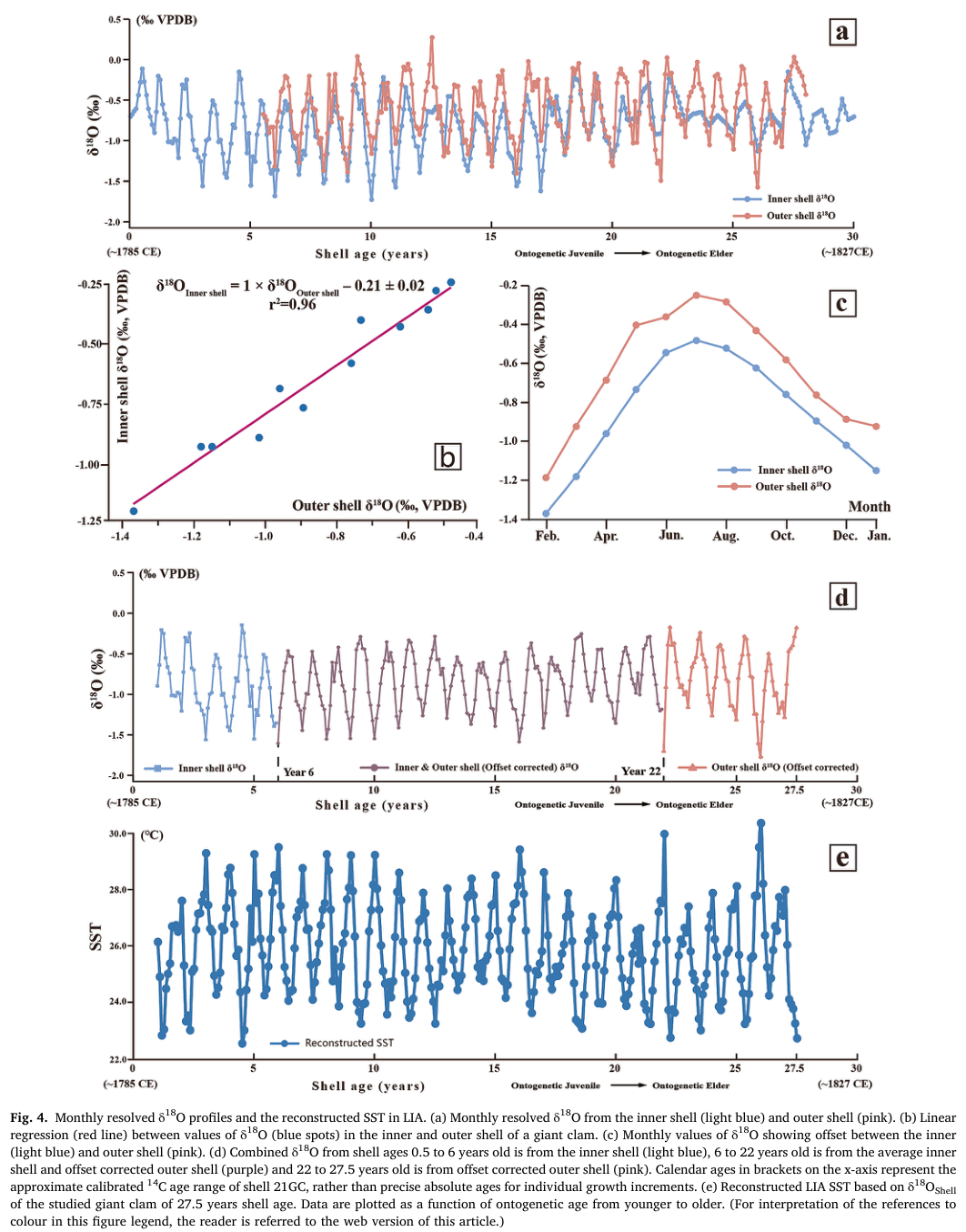
Dong and colleagues' study, published online on September 13, 2026, examined Tridacna gigas specimen 21GC from Jiigurru. The shell was collected in 2015 and preserves roughly thirty years near the end of the Little Ice Age.
The researchers adapt traditional ONI criteria to reconstructed local temperature anomalies: a three-month mean, a ±0.5°C threshold, five consecutive overlapping seasons and a window including November–January. This local classification does not provide Niño 3.4 measurements.
NOAA's Climate Prediction Center announced its move to RONI in February 2026. Its explanation says that a lagged thirty-year reference climate can struggle to keep pace with changes in tropical temperatures. Comparing the ENSO region with the global tropics reduces dependence on that reference period. This is an operational monitoring change, separate from the shell study's historical reconstruction.
The current ERSSTv6 RONI table describes a 1991–2020 reference period and Niño 3.4 between 5°N and 5°S, 120°W and 170°W. It subtracts mean tropical temperature anomalies across 20°N–20°S and then adjusts the difference to preserve the original Niño 3.4 index's variance. The table retains a three-month average and five overlapping seasons for historical classification. Recent values may be revised for two months after first posting.
Those inputs reveal why changing a label is insufficient. A reconstructed temperature anomaly from Jiigurru is neither the required Niño 3.4 regional average nor the matching tropical-ocean mean. The shell study does not reconstruct the two spatial series needed for that subtraction. A threshold shared by two methods cannot make their underlying quantities interchangeable. This is a comparison of documented methods, not a recalculation of the authors' event counts.
The ten local episodes comprise five warm and five cold responses. A separate strength test uses an absolute standardised proxy anomaly exceeding one standard deviation, identifying three strong cold responses. That local test is distinct from RONI's variance adjustment.
The authors cannot assign precise calendar years to individual anomalies or match them individually to other archives. They also reject treating local cold-response predominance as definitive evidence of Pacific-wide Walker circulation reorganisation.
For English-language readers comparing historical reef research with NOAA monitoring, the useful question is which information supports each classification. The shell adds seasonal detail to a scarce tropical marine archive. The operational index needs geographically broader temperature fields and has its own reference period and revision rules. Neither can replace the other by retaining a familiar 0.5°C threshold. The study's local result remains informative within its stated scope, without becoming a modern index series or a forecast.
The accompanying AI-generated conceptual illustration shows a small shell form beside broad abstract ocean layers. It is not a photograph of specimen 21GC, a climate data plot or a depiction of measured index inputs.
 프리즘코리아 편집국 > Nguyễn An