Jiigurru giant-clam archive of late Little Ice Age climate
A30-year seasonal reconstruction from Tridacna gigas21GC in Australia's northern Great Barrier Reef, examining salinity assumptions, chronology and limits of rainfall and local ENSO-like proxies.
Issue summary & timeline
AI SUMMARY · SONNET
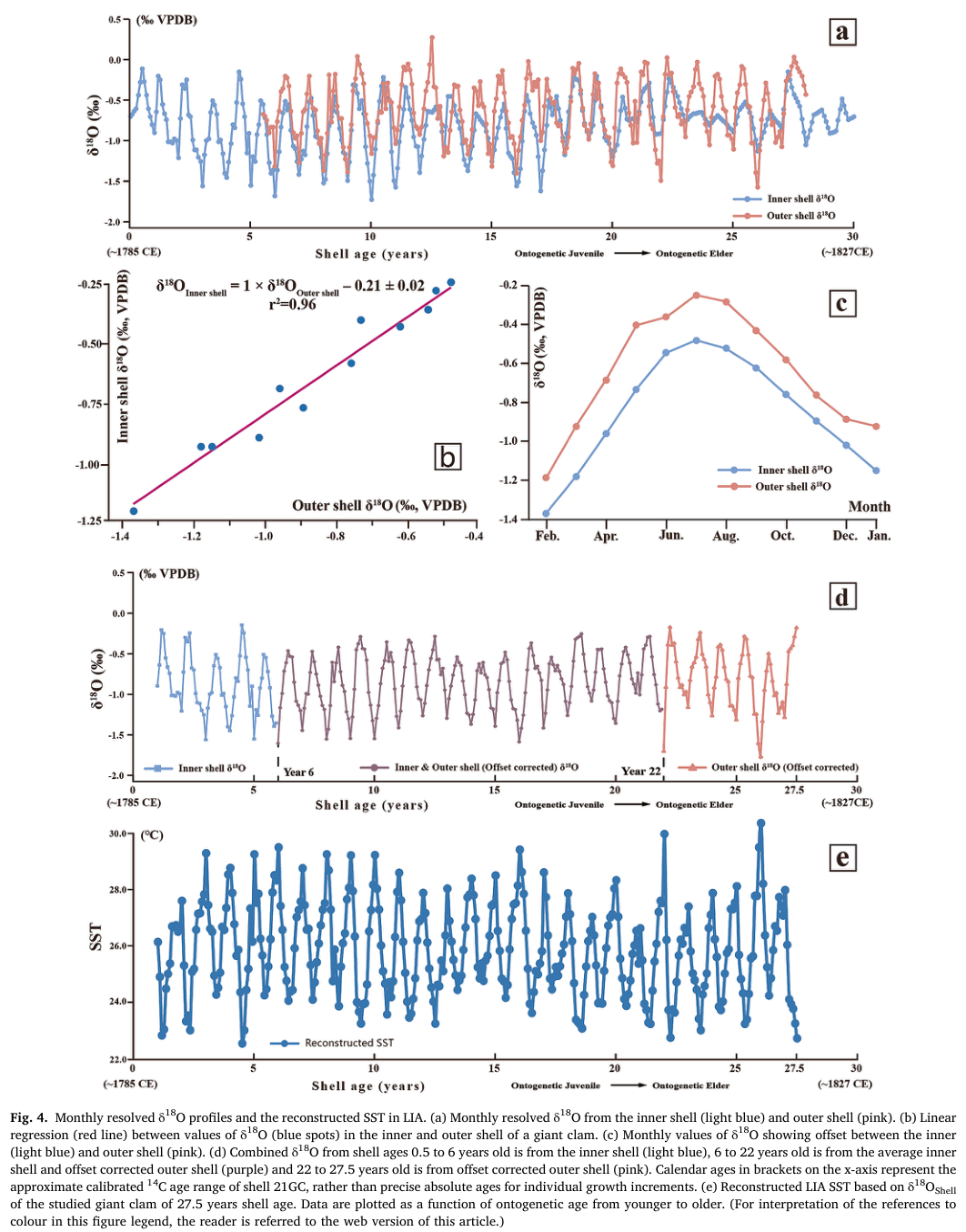
A study by Bohao Dong and colleagues, published online in Global and Planetary Change on Sept 13, 2026, reconstructs ~30 years of monthly climate signals from one dead Tridacna gigas giant clam (specimen 21GC) collected in 2015 at Jiigurru (Lizard Island Group), Great Barrier Reef. Growth slowed with age, smoothing isotope signals in older inner-shell sections, so researchers merged 784 inner/outer-layer samples onto a common scale via spline interpolation—meaning reconstructed years vary in reliability. Follow-up coverage stresses limits: reported analytical uncertainties (0.05‰ carbon, 0.10‰ oxygen) describe lab measurement precision, not full climate error bars; some data points were excluded with reasons given but underlying rejected values undisclosed; temperature conversion relies on untested seawater-isotope assumptions; and the shell's ten local warm/cold episodes, classified using adapted ONI-style criteria, cannot be equated with NOAA's new Relative Oceanic Niño Index (adopted Feb 2026), which requires broader Pacific/tropical spatial data the single-specimen record lacks.
The Jiigurru shell records one reef location. NOAA's relative index requires both equatorial Pacific and tropical-ocean temperature fields, making a shared threshold insufficient to convert the study's local event count.
The Jiigurru clam study reports laboratory isotope uncertainties and identifies excluded data points. Its released workbook and conversion methods show why that precision cannot be treated as the total uncertainty of reconstructed temperature or rainfall.
The Jiigurru study combines selected inner and outer shell records because growth slows with age and isotope values differ between layers. A monthly analysis grid does not make every sample an equally detailed month.