A clam’s monthly climate archive depends on joining two imperfect shell layers
The Jiigurru study combines selected inner and outer shell records because growth slows with age and isotope values differ between layers. A monthly analysis grid does not make every sample an equally detailed month.
A giant clam can grow for decades without laying down equal amounts of shell in each year. That matters for a new reconstruction of climate at Jiigurru, also known as the Lizard Island Group, in Australia's northern Great Barrier Reef. The research team did not simply drill along one shell layer and label equally spaced samples as equally spaced months. It combined selected portions of two layers after checking their growth and isotope behaviour.
The study by Bohao Dong and colleagues, published online in Global and Planetary Change on September 13, examined one valve of a dead Tridacna gigas collected in 2015. Microscopic increments and annual oxygen-isotope cycles indicated a lifespan of about 30 years. The authors used 784 powdered samples: 307 from the inner layer and 477 from the outer layer. Those are sampling counts, not 784 separate months of climate observations.
In the inner layer, annual growth rose from about four to ten millimetres during the first four years, then declined to about two millimetres by age ten. From around age twenty, increments narrowed to roughly one millimetre a year. A fixed distance drilled through a slowly growing section therefore represents more time than the same distance in a faster-growing section. The study reports that this averaging smoothed seasonal oxygen-isotope peaks and troughs in the older inner layer.
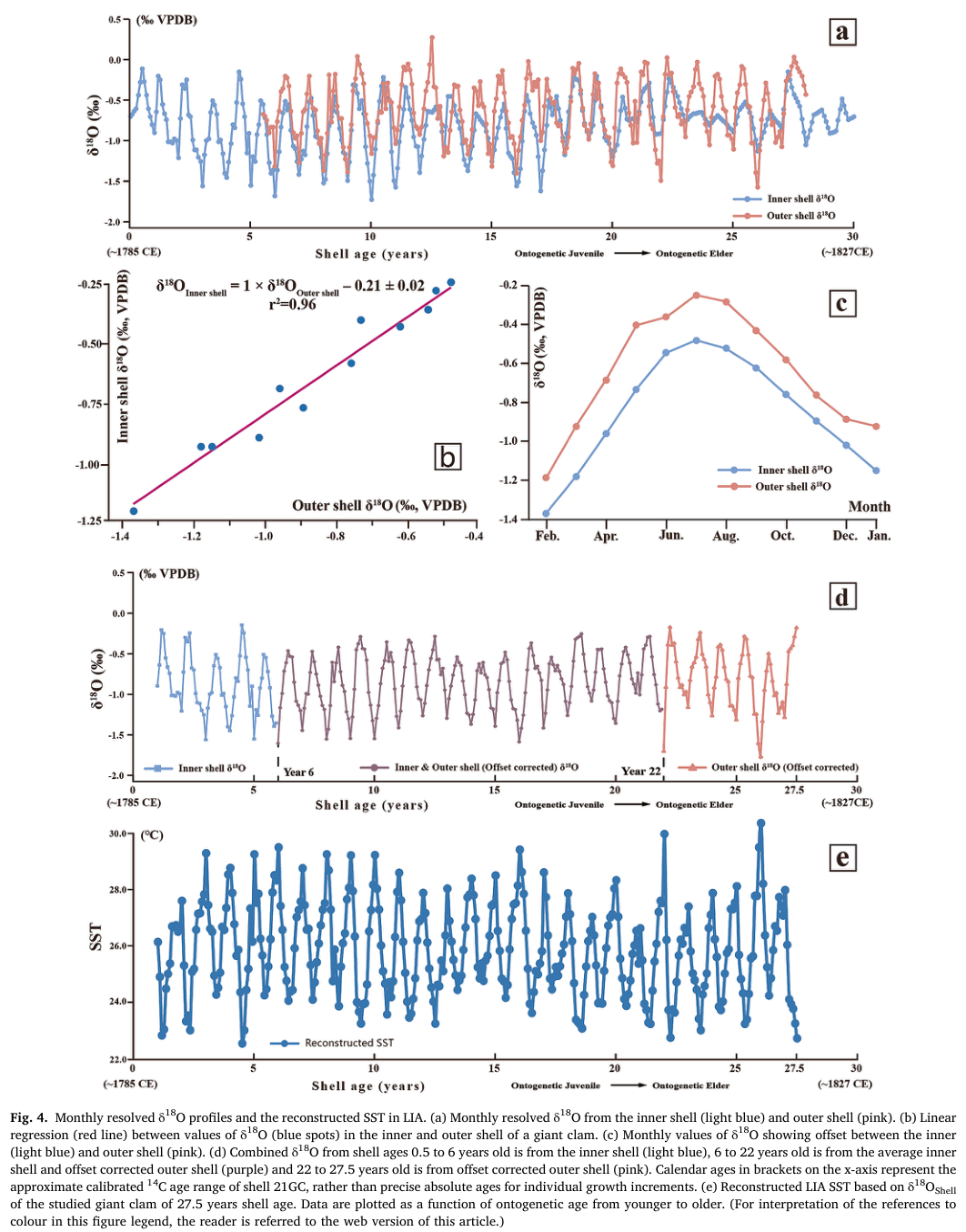
To limit that problem, the authors used inner-layer isotope data from shell ages one to twenty-two in their subsequent environmental reconstruction. The outer layer preserved more uniform seasonal variation, but it brought a different limitation: surfaces can be eroded or altered, and the boundary between layers can be hard to follow. In this specimen, the usable outer-layer record extended from roughly age six to twenty-seven and a half after incomplete end segments were excluded.
The two records also had to be put on a common isotope scale before being joined. The team compared average monthly oxygen-isotope values over the shared interval between ages six and twenty-two and reported a strong correlation, with an R-squared of 0.96. Yet the inner-layer values were consistently about 0.21 parts per thousand lower. The team applied that offset to the outer record. Strong correlation showed similar variation; it did not eliminate the difference in their absolute values.
The final combined series uses the inner layer for ages half a year to six, the average of inner and adjusted outer values for ages six to twenty-two, and adjusted outer values from age twenty-two to twenty-seven and a half. This is why a shell with an approximately thirty-year lifespan does not supply thirty equally complete years in every reconstructed series. The biological lifespan, each layer's usable interval and the merged isotope record answer different questions.
The team converted distances along the shell into chronological coordinates and used spline interpolation to resample the isotope records to twelve points a year. A monthly grid helps compare records with different growth rates. It cannot restore seasonal detail already averaged within a powder sample, which is why excluding the smoothed older inner section remained necessary. The paper also reports no obvious warm-versus-cold seasonal growth-rate trend in this specimen; the principal sampling problem identified here was the decline in growth with age.
For English-language readers assessing the claim of a month-by-month climate archive, the useful distinction is between the shell's physical growth, the information retained by a sampled interval and the time grid created during analysis. The combined record is a reconstruction from one specimen, with explicit choices about what to retain and how to align it. It is neither a sequence of direct thermometer readings nor an unbroken modern monitoring record. Its value lies partly in those documented checks, which make the limits of the archive visible.
 프리즘코리아 편집국 > Nguyễn An