Chile's CTAO-South gamma-ray site to gain two Large-Sized Telescopes
ESO announced on 19 November 2026 that CTAO-South at Paranal will add two Large-Sized Telescopes, bringing the site to 53 telescopes and extending its reach to lower gamma-ray energies.
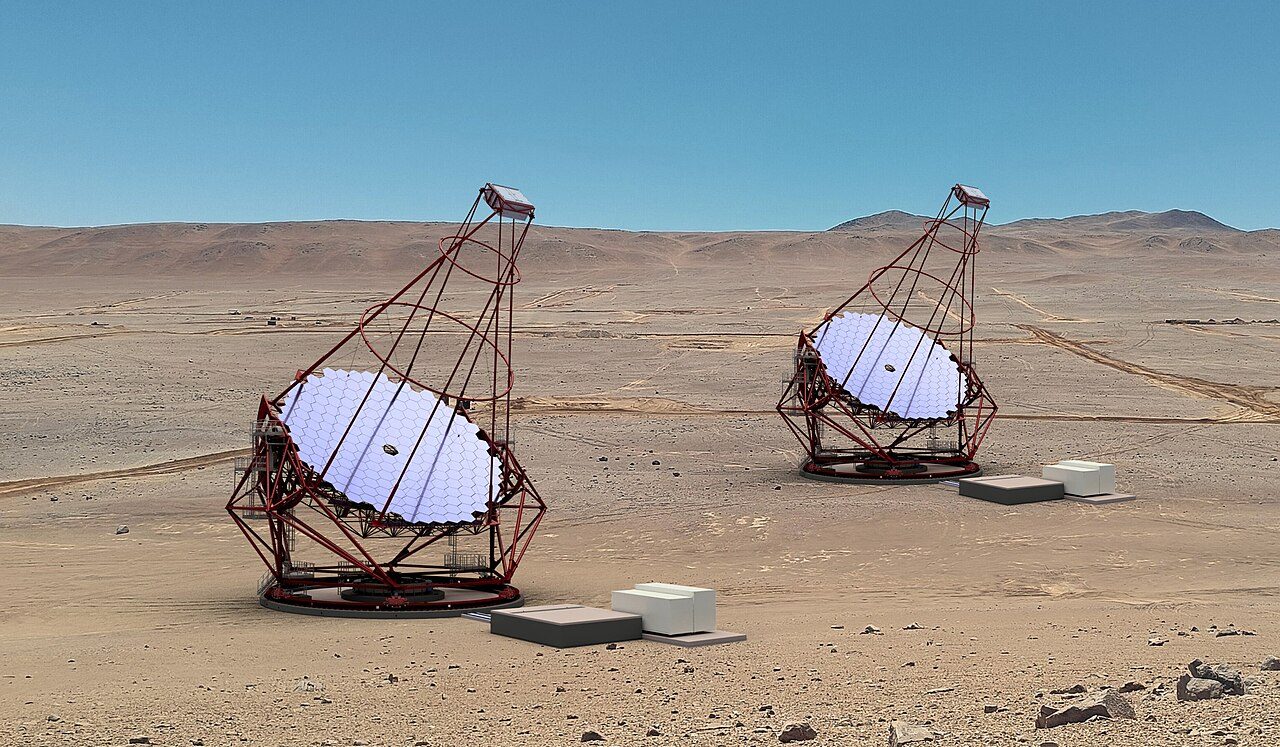
The southern site of the Cherenkov Telescope Array Observatory (CTAO), which the European Southern Observatory (ESO) hosts and operates at Paranal in Chile's Atacama Desert, will now include two Large-Sized Telescopes (LSTs). ESO announced the change on 19 November 2026, saying it brings the total number of telescopes at the site to 53.
Until now, only CTAO-North on La Palma in Spain was planned to have LSTs. The Chilean site was designed around the Small-Sized Telescopes (SSTs) and Medium-Sized Telescopes (MSTs), which cover medium and high gamma-ray energies. An Italian report on the decision describes the earlier plan as 37 SSTs and 14 MSTs, which matches the 53 total once the two new telescopes are added.
The new layout is called the Beta Configuration. CTAO as a whole is designed to observe gamma rays from 20 GeV to 300 TeV, and the LSTs handle the lowest energies. According to ESO, the addition improves CTAO-South's sensitivity by a factor of two between 50 and 80 GeV and by roughly 25 percent between 80 and 300 GeV. ESO also says LSTs can point to anywhere in the sky in under 30 seconds, which matters for catching short-lived transient events.
The southern LSTs are not copies of the northern ones. ESO says their design, coordinated by Italy's National Institute for Astrophysics (INAF), is optimised for conditions in the Atacama. The Italian outlet AstroSpace reports that the structure was reworked to withstand the frequent earthquakes in the region and that each telescope weighs about 160 tonnes, roughly 60 tonnes more than the northern units. It also reports a 23-metre mirror and a camera built by the National Institute for Nuclear Physics (INFN) with 1,855 light sensors. These details come from AstroSpace rather than from the ESO announcement.
Funding comes largely from Italy. ESO says the additional telescopes are made possible to a major extent by the PNRR-CTA+ project, funded by the Italian Ministry of University and Research and coordinated by INAF together with INFN, several Italian universities and international partners in the CTAO LST Collaboration. AstroSpace adds that a second ministry programme, CTA++, is to fund the installation in Chile. Neither source gives a total cost.
Site work is already under way. ESO reports that 17 kilometres of roads have been built and that foundations for the SSTs and MSTs are finished. Preparations for the LSTs have begun, and foundation construction is expected to be completed by the end of the year. Neither ESO nor AstroSpace gives a date when the new telescopes will be built or begin observing, so that timeline remains open.
CTAO was established as a European Research Infrastructure Consortium in January 2025, with its headquarters in Bologna. In AstroSpace's account, CTAO scientific head Roberta Zanin said that lowering the energy threshold to 20 GeV will let astronomers study a larger volume of the Universe and look further back in time. That quote is an English rendering of the Italian original.
 프리즘코리아 편집국 > Nguyễn An