A precise isotope measurement is not a complete error bar for ancient climate
The Jiigurru clam study reports laboratory isotope uncertainties and identifies excluded data points. Its released workbook and conversion methods show why that precision cannot be treated as the total uncertainty of reconstructed temperature or rainfall.

The laboratory can measure the chemistry of an old giant-clam shell precisely without knowing the past climate with the same precision. That distinction emerges from the methods and released data of a new study of specimen 21GC from Jiigurru, also known as the Lizard Island Group, in Australia's northern Great Barrier Reef. Its reported analytical uncertainties describe isotope measurements. They are not complete error bars for the temperatures or rainfall inferred from those measurements.
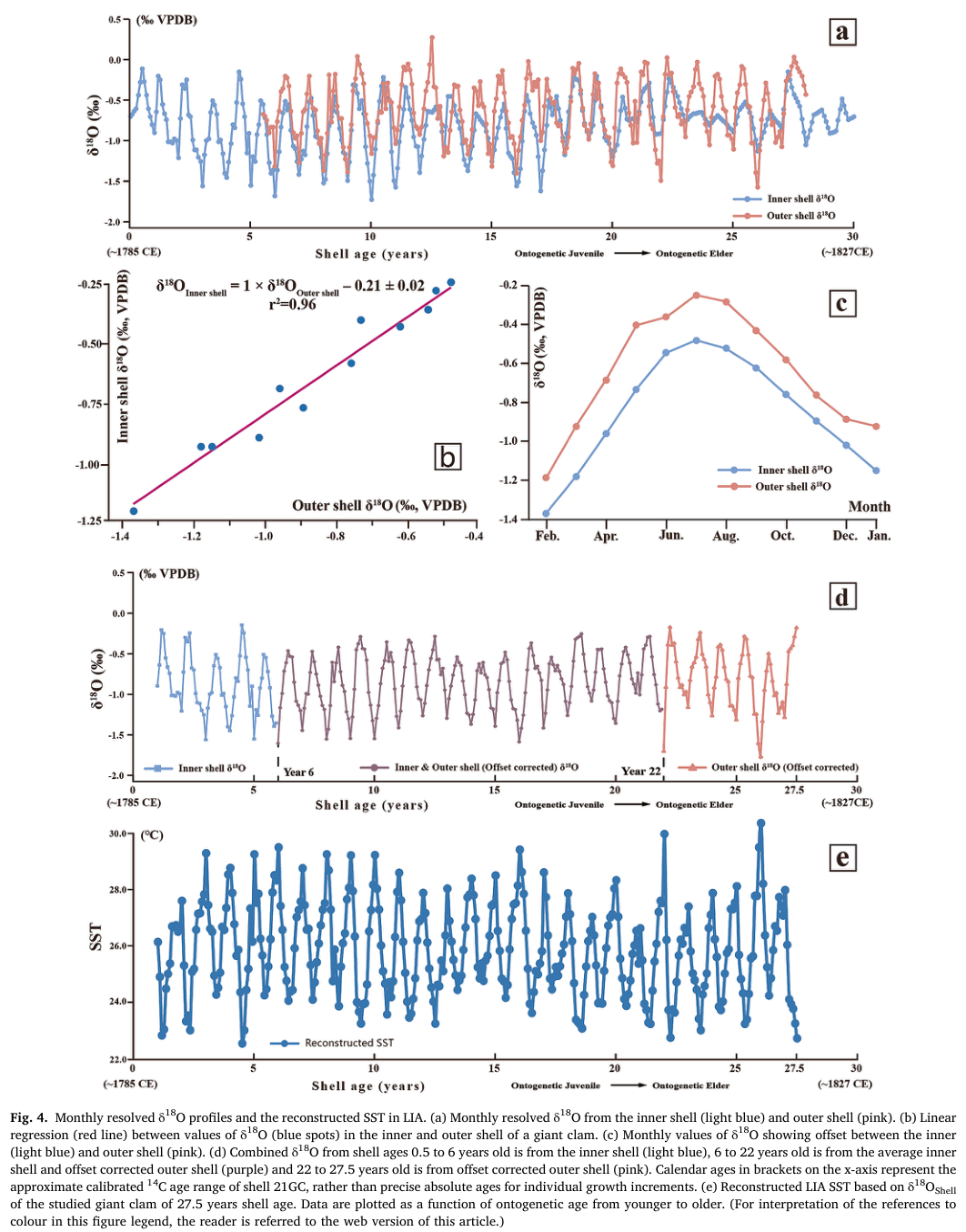
Bohao Dong and colleagues published the study online in Global and Planetary Change on September 13, 2026. They analysed one valve of a dead Tridacna gigas collected in 2015, using its growth and chemistry to investigate roughly thirty years near the end of the Little Ice Age. For readers evaluating environmental measurements, the useful question is how a number moves from a laboratory result to a claim about an earlier sea.
The isotope analysis began with milled shell powder. The researchers weighed portions of 0.55–0.65 milligrams into sealed vials, heated them to 70°C, purged ambient air with helium and added phosphoric acid to release carbon dioxide. A mass spectrometer then analysed the gas. These are preparation and measurement steps, rather than observations of the sea at the time the animal lived. The paper reports analytical uncertainties of 0.05 parts per thousand for carbon isotopes and 0.10 parts per thousand for oxygen isotopes.
The isotope numbers also have a defined reference scale. The shell results were reported relative to Vienna Pee Dee Belemnite, or VPDB. Three internal standards were normalised to that scale after calibration against the international standards NBS-18 and NBS-19. A reference scale makes the laboratory values interpretable and comparable. It does not by itself establish which environmental process produced every variation in a biological shell.
The released data expose another step between measurement and reconstruction: deciding which observations to retain. The methods name two inner-layer points, 21GC-026 and 21GC-281, as excluded because their results exceeded two standard errors of uncertainty. A third point, 21GC-O-308 from the outer layer, was removed as an anomalous isolated jump. The supplementary workbook's geochemical raw-data sheet contains the corresponding labelled rows, with blank carbon- and oxygen-isotope cells; the outer label is written there as GC-O-308. Those blanks do not mean the isotope ratios were zero.
That transparency allows readers to identify the exclusions, but it has a limit. Empty cells are not the rejected numerical results. The published workbook alone therefore cannot show the size or direction of each removed value, or allow a full reconstruction of how retaining those values would alter the final climate series. This is a specific boundary of the released material, not evidence that the exclusions were wrong. The paper states its reasons, while the missing rejected values restrict an independent numerical sensitivity check.
Temperature conversion introduces further quantities. The equation adopted by the study combines measured shell oxygen isotopes on the VPDB scale with estimated seawater oxygen isotopes on the Vienna Standard Mean Ocean Water, or VSMOW, scale. Its temperature sensitivity is about 4.76°C per one-part-per-thousand change in the isotope difference. As a simple illustration, changing only that difference by 0.10 parts per thousand would change the calculated temperature by about 0.48°C. This arithmetic is a conditional sensitivity calculation, not the paper's total temperature uncertainty, confidence interval or uncertainty in a multi-year average.
The seawater term was not directly measured for the historic period. The authors estimated it from modern salinity and separately tested modern monthly salinity variation. Choices about the conversion relationship, seawater composition, shell-layer adjustment and time assignment remain distinct from the mass spectrometer's analytical uncertainty. Improving one laboratory measurement cannot automatically remove uncertainty in those other inputs. Conversely, an assumption-dependent reconstruction does not make the underlying isotope measurements meaningless.
Carbon isotopes add a different distinction between precision and environmental specificity. The laboratory's smaller reported carbon-isotope uncertainty does not mean rainfall has been reconstructed more precisely than temperature. The authors interpret the carbon record as a qualitative signal of precipitation-related seasonality, influenced by hydrology and biological processes. They do not provide a validated formula that turns the analytical uncertainty into millimetres of historical rain. Comparing two isotope uncertainty numbers cannot rank the accuracy of two different climate inferences.
For English-language readers of reef and climate research, these stages provide a practical way to assess the archive: check what was measured, the reference scale, the documented exclusions, and the assumptions used for environmental conversion. The Jiigurru study supplies a detailed marine record and explicit methodological choices. Its laboratory precision should be read at the measurement stage where it was reported, while the climatic interpretation requires a wider account of assumptions and limitations. The accompanying image is an AI-generated conceptual illustration, not a photograph of the specimen, laboratory equipment or research results.
 프리즘코리아 편집국 > Nguyễn An