Why Florida's hardest-hit coral site became a shade test—and what that choice limits
Newfound Harbor lost 43.1% of monitored brain and boulder coral colonies during the 2023 Florida Keys heatwave, while seven of nine study reefs saw little recorded mortality. Researchers chose the damaged site and two vulnerable species for a 2024 shade trial. That history explains the experiment's focus, but the years and coral groups differ: darker shaded colonies in 2024 do not establish that the devices prevented deaths on the scale seen in 2023.
Why test coral shade at Newfound Harbor rather than on another Florida Keys reef? A study of the 2023 marine heatwave supplies the reason: this inshore site suffered unusually severe losses among monitored brain and boulder corals. A second paper, published in October 2026, says the researchers deliberately returned to that site in 2024 and selected two vulnerable brain-coral species for an intervention. Read together, the studies show how the trial was targeted. They do not form a before-and-after experiment proving that shade saved the corals that would otherwise have died.
The earlier research followed more than 4,200 identified coral colonies across five offshore and four inshore Florida Keys reefs. The monitoring program already existed before the 2023 heatwave, so investigators could revisit colonies through the event rather than infer mortality from color alone. At seven of the nine reefs, only 0–2% of the tracked brain and boulder colonies experienced recorded mortality. Newfound Harbor and Cheeca Rocks were the sharp exceptions. The broad regional bleaching episode therefore did not produce one uniform death rate for these monitored growth forms.
At Newfound Harbor, 510 colonies were monitored at the first heatwave visit. The research team ultimately reported complete death in 43.1% of monitored colonies and partial tissue loss from bleaching or black band disease in another 12.3%. Cheeca Rocks recorded about 30% complete mortality. The Newfound Harbor percentage refers to that fate-tracked group over the 2023 event, not to every coral on the reef, every coral species in Florida, or the probability that a single colony will die in a future summer. The study's offshore finding also concerns its monitored brain and boulder corals; it does not describe the fate of all branching corals.
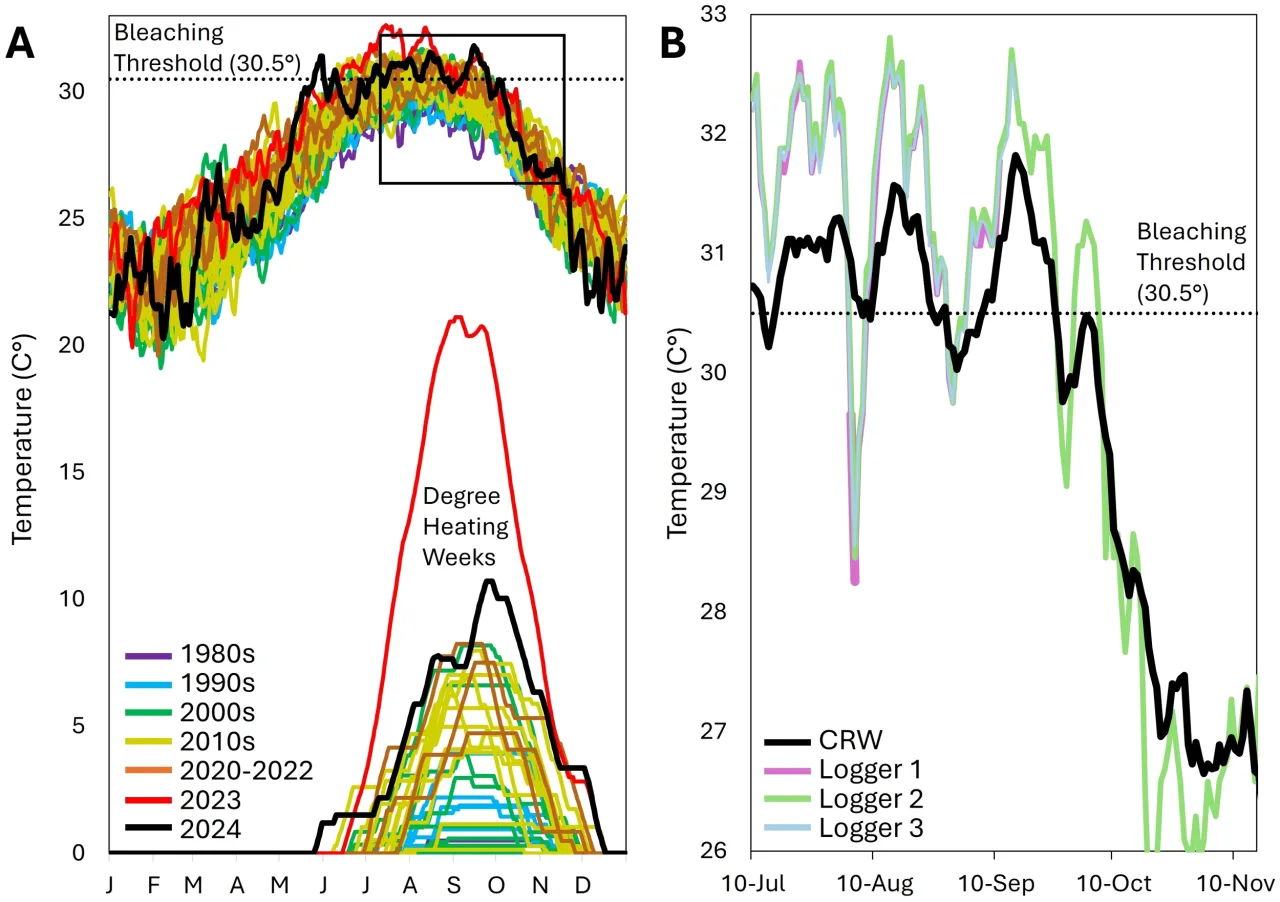
The 2023 paper identifies both a site effect and a species effect. At the two heavily affected reefs, brain corals generally lost more tissue than boulder corals under the same heatwave. At Newfound Harbor, 2023 deaths were already visible at the first July assessment. A seabed temperature logger had recorded 34.06°C on July 10, about two weeks earlier. The authors consider an extreme temperature peak a possible explanation for rapid losses, while acknowledging that the exact causal pathway was not experimentally established. A cumulative satellite heat index alone cannot reconstruct each colony's exposure or prove which mechanism killed it.
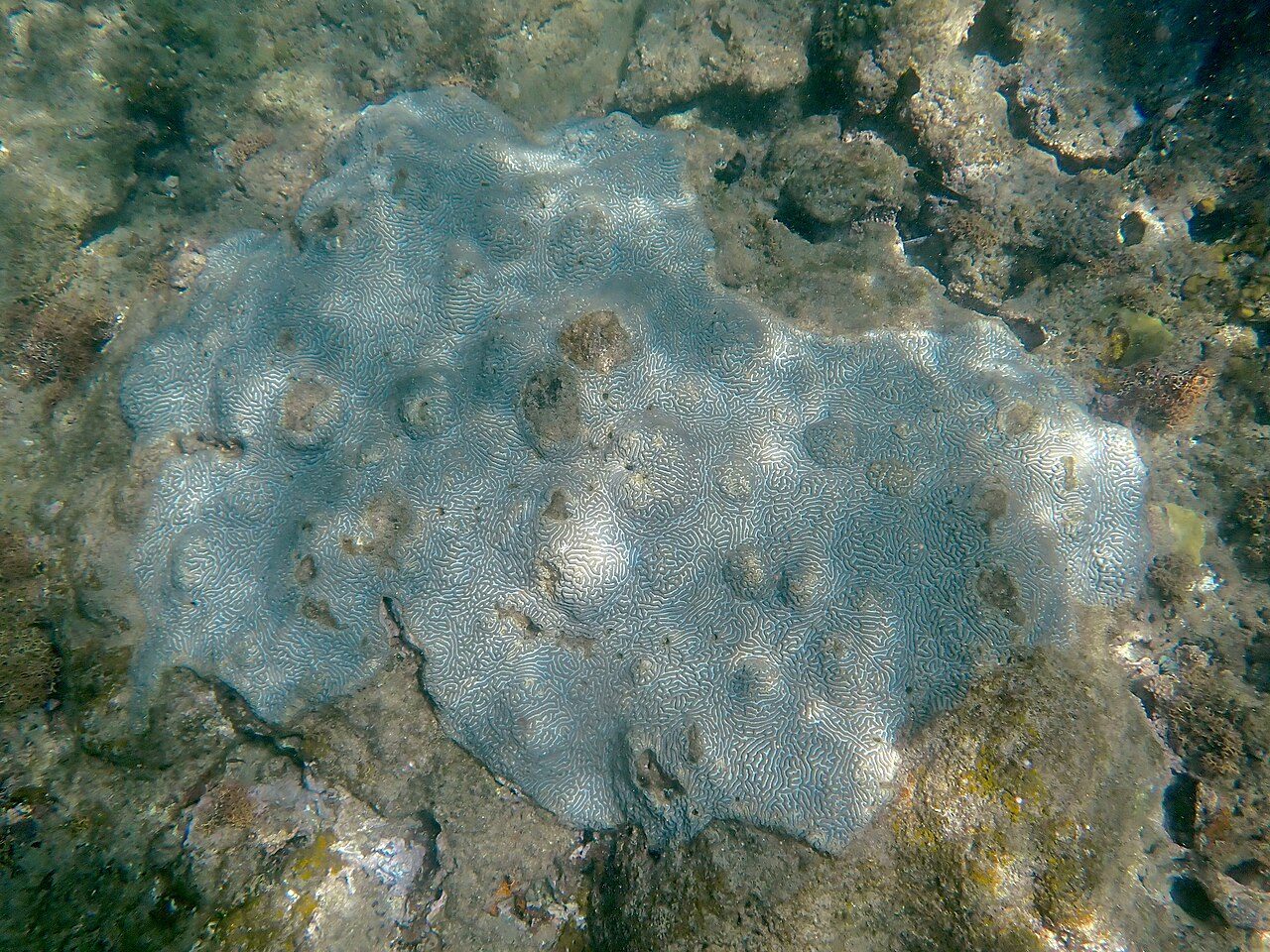
That evidence shaped the next study's design. The 2026 shade paper explicitly says Newfound Harbor and highly susceptible corals were selected because of the preceding losses. In 2024, the team enrolled 20 Pseudodiploria clivosa and 20 Colpophyllia natans colonies on the site's hardbottom plain, divided between shaded and unshaded treatments. The colonies had to fit size requirements for an individual floating frame. Permit rules kept shaded colonies spatially separated. This was a targeted test in one place with two species and 40 selected colonies, not a random sample of all Florida Keys reefs.
The different summers matter. The 2024 site experienced its second-highest cumulative heat stress in the satellite record cited by the shade authors, surpassed only by 2023. Yet the 2024 corals showed relatively mild to moderate paling. The researchers observed darker tissue in shaded colonies during peak stress, but no bleaching-related deaths in either the shaded or comparison group. One colony's tissue was damaged after a storm dislodged it. With no heat-related deaths to separate the groups, the trial cannot quantify a survival advantage from shade. Subtracting the 2024 death count from the 2023 mortality percentage would compare different colonies, conditions, and years.
There may also have been a biological difference among the survivors. The 2024 paper found heat-tolerant Durusdinium algae dominant in the sampled corals and raises the possibility that the exceptional 2023 heatwave favored surviving colonies with those partners. It had no pre-2023 symbiont samples from those experimental colonies, so a change caused by the previous summer remains a hypothesis. This uncertainty reinforces the need for a study that records the starting biology of each colony, not merely the shade treatment and its later color.
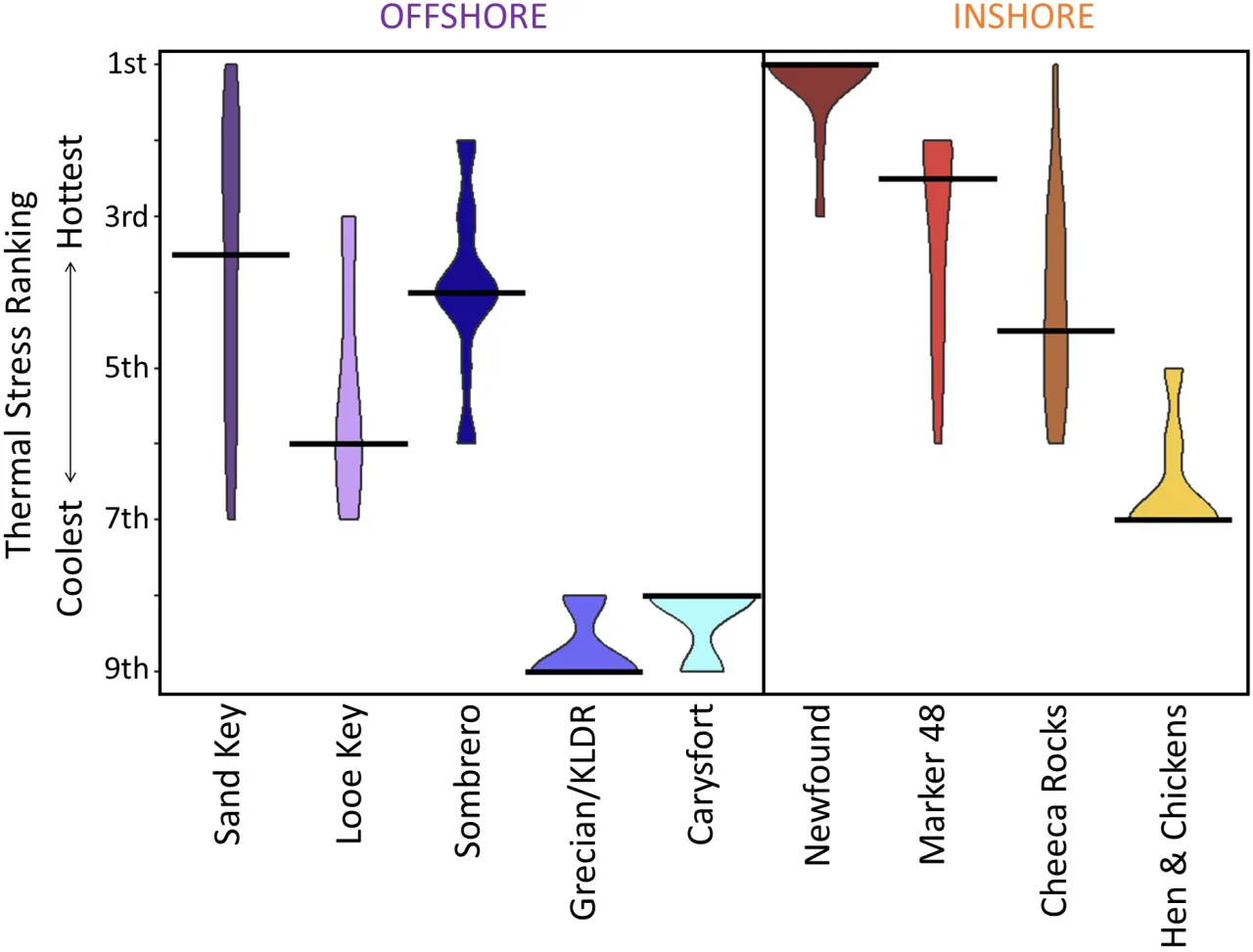
The historical chart accompanying this article is Figure 11 from the 2024 mortality paper. It compares the relative heat-stress ranking of nine reefs across years when at least one exceeded four degree heating weeks from 1985 to 2023. Newfound Harbor repeatedly ranks among the warmer sites, but the authors warn that year-by-year positions vary and that a single hot season should not dictate all restoration decisions. This is background context for site selection, not a photograph or result from the 2024 shade deployment.
For conservation teams, the two studies support a careful sequence: document which sites and species actually suffer loss, choose an intervention question for those populations, then test outcomes that go beyond color, including future tissue retention and survival. Newfound Harbor was a rational site for asking whether an individual shade frame could change visible paling in vulnerable brain corals. The answer on survival, other species and other reefs remains open. The site-selection logic is evidence; a region-wide protective effect is still to be demonstrated.
 프리즘코리아 편집국 > Nguyễn An