Uranus reaches opposition November 25. Binoculars can help you find it
Uranus will stand opposite the Sun in Taurus on November 25. That geometry makes it a good target, but at about magnitude 5.6–5.7 and just after a full Moon, it can still be hard to distinguish from a star.
Uranus reaches opposition on November 25, 2026. From Earth, the planet will appear on the side of the sky opposite the Sun. That puts it above the horizon for much of the night, but it does not mean Uranus will be conspicuous. The Astronomical Society of Edinburgh puts it at magnitude 5.6 around opposition; the Saint Louis Science Center's guide gives 5.7 for its November 17–27 observing window. Both put it in Taurus and recommend binoculars for most observers.
The Saint Louis planetarium guide places Uranus between the Pleiades and Hyades star clusters. Those clusters are good landmarks for finding the area, not for identifying the planet by themselves. Use a current finder chart for your location and date to match the nearby pattern of stars, then look with binoculars. The science center puts the full Moon on November 24, one day before opposition. If moonlight washes out the field on the 25th, a clearer or darker evening around that date may be more useful than trying to observe at the precise moment of opposition.
The useful test comes on a second night. The Edinburgh society suggests returning a few nights later and comparing the candidate's position against the same stars. A small shift relative to that pattern helps distinguish the planet from an ordinary background star. A small telescope can show Uranus as a tiny disk rather than a point, but even then there is little detail to see.
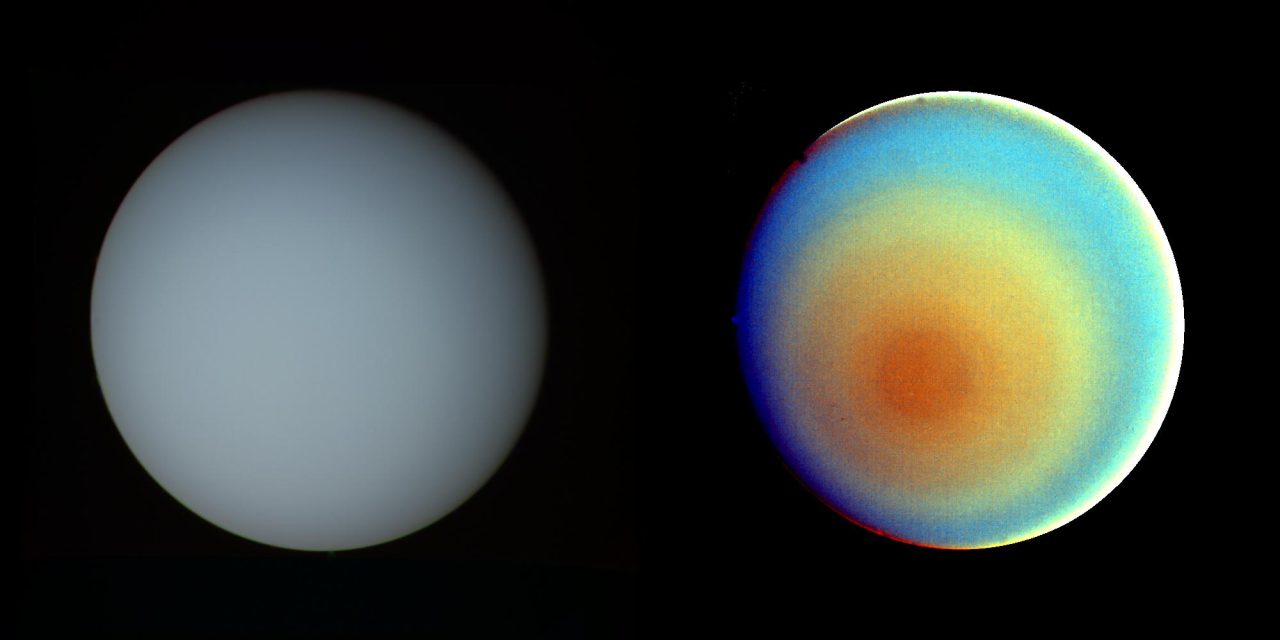
The two disks in the accompanying archival image are something different. NASA's Voyager 2 returned the underlying images on January 17, 1986. The left panel uses filters combined to approximate natural color from the spacecraft's viewpoint; the right stretches contrasts in false color to reveal subtle polar structure. NASA/JPL identifies the bright orange and yellow strip along the edge in the enhanced panel as an image-processing artifact. Neither view is a forecast of what a telescope on Earth will show this November.
 프리즘코리아 편집국 > Alex Rowan