Tokyo buses extend a Chiba rail disruption shuttle beyond October 2
Tokyo has sent ten buses and crews to reinforce a direct Nagaura–Anegasaki link after Typhoon 25 disrupted the Uchibo Line. The revised service began October 1, costs ¥440 for adults and will continue until JR East launches its own replacement transport. It covers only part of the closed corridor; JR rail tickets and passes cannot be used on these separate buses.
A temporary bus link on Chiba's disrupted Uchibo corridor changed substantially on October 1. Tokyo's transport bureau says it dispatched ten Toei buses and drivers to support direct trips between Nagaura Station and Anegasaki Station's west exit. The first supported departure left Nagaura at 6:40 a.m. with 45 passengers, according to the bureau's same-day report. This is a documented service operation, not simply a proposal for a future rail substitute.
The link had initially been announced by local operator Kominato Railway for September 30 through October 2. A September 30 operator notice says the added Tokyo support brings more departures and extends the period from October 1 until JR East begins its own replacement transport. The wording sets a condition for ending the service, not a fixed end date. JR East's line status, checked at 10:08 p.m. Japan time on October 1, still says it is trying to secure vehicles for its replacement buses between Anegasaki and Kisarazu; it does not give a start date for that separate operation.
The distinction in geography is just as important. The temporary direct buses run between Nagaura and Anegasaki, without intermediate stops, according to Tokyo's announcement. The suspended rail section extends from Anegasaki to Kisarazu. Nagaura lies within that wider gap, so a bus from Nagaura to Anegasaki can help one part of a journey but does not establish a bus ride all the way from Kisarazu. A person starting south of Nagaura has to verify a way to reach the bus stop separately rather than read a partial link as a restored through route.
The revised public timetable lists 20 departures in each direction. From Nagaura, the first is 6:40 a.m. and the last 6:00 p.m.; from Anegasaki west exit, the first is 7:15 a.m. and the last 6:35 p.m. Those endpoints show why a late evening rail journey cannot be assumed to have a bus connection. The timetable is a planned service schedule, and both Tokyo and Kominato warn that traffic conditions or restrictions may delay or cancel a trip. Neither document supplies measured seat availability for an individual departure.
A one-way ride costs ¥440 for an adult or ¥220 for a child. Cash and transport IC cards are accepted. Kominato's operator notice explicitly says this is a separate framework from the JR replacement buses being arranged, so JR tickets and commuter passes cannot be used to board it. For a passenger who already owns a rail pass, the fare is therefore an additional bus payment under the announced terms; any separate rail refund or pass adjustment would need to be assessed through JR's applicable process.
The ten vehicles are described as Tokyo's operational support, coordinated with Kominato. Tokyo says revenue from these temporary buses will later be donated to the affected area. That is an announcement about the proceeds, not evidence that the buses are free to ride or that a particular relief recipient has already received money. The bureau reported 45 riders on the first supported trip, but gave no day-long total or comparison with demand before the rail closure. One departure cannot establish that capacity now meets all commuting and school travel needs.
JR East's October 1 status still lists Anegasaki–Kisarazu as suspended in both directions throughout the day and estimates at least roughly three months before rail service resumes, subject to change. It also shows reduced service on the rail portions on either side. This means a traveller needs to check three different pieces of a proposed journey: the trains that actually run, the Nagaura–Anegasaki temporary bus, and any travel needed across the rest of the closed section. Tokyo's October 1 report verifies that one interim link has begun; it does not announce the end of the wider Uchibo disruption.
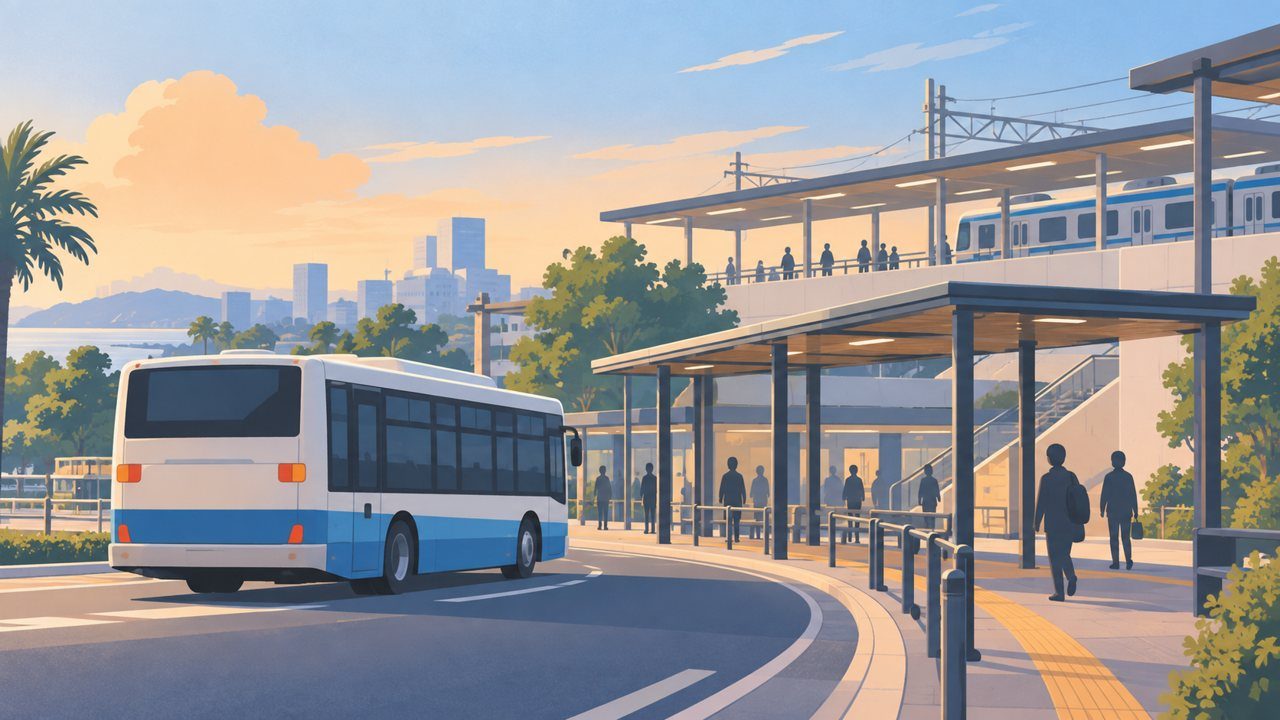
This report relies on operator and municipal notices, not an inspection of a bus stop or a passenger interview. The accompanying illustration is generated conceptual artwork showing a generic bus and rail interchange. It is not a photograph of the October 1 service, a real station, or typhoon damage.
 프리즘코리아 편집국 > Camila Ríos