Why black hole jets glow at the edges: a Centaurus A simulation points to electron physics
A Würzburg-led team says a simulation with direction-biased electrons reproduces the edge-brightened jet seen by the Event Horizon Telescope in Centaurus A, though several mismatches remain.
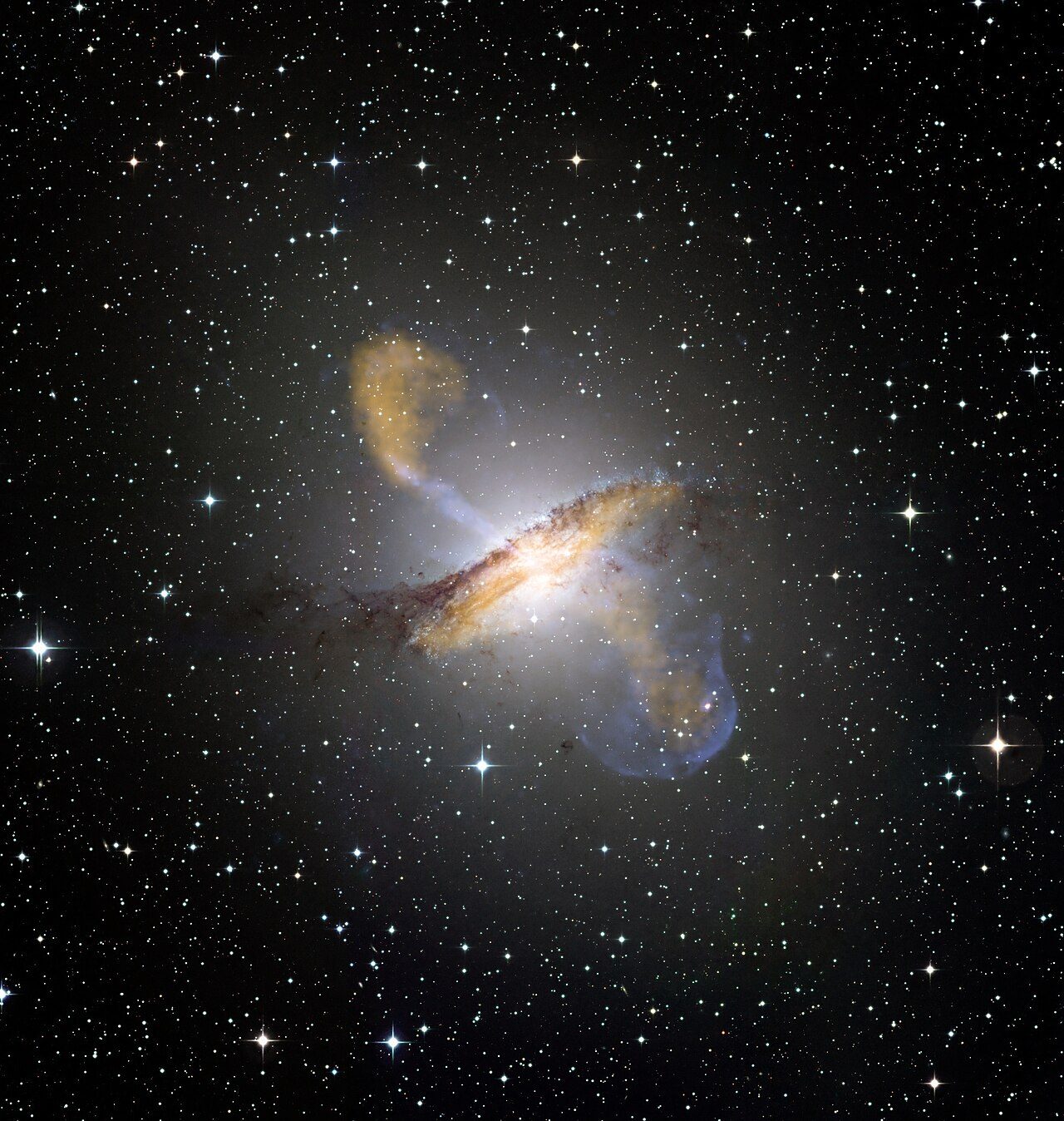
Radio images of the jet at the heart of Centaurus A, the nearby galaxy NGC 5128, show something that looks backwards at first glance: the jet is brightest along its outer edges rather than down its middle. A paper in Astronomy & Astrophysics, published online on Oct. 1, 2026, argues that a computer simulation can reproduce that pattern if the electrons in the jet do not move randomly.
The Event Horizon Telescope (EHT) imaged the base of the Centaurus A jet at a wavelength of 1.3 millimetres; the image, published in 2021, was built from 2017 data and shows emission concentrated at the jet's outer edges, a pattern called limb brightening. The new work, led by Felix Glaser of the University of Würzburg with co-authors at institutions including Goethe University Frankfurt, the University of Turin, Shanghai Jiao Tong University, Radboud University Nijmegen and the Max Planck Institute for Radio Astronomy, asks what physics could produce it. The paper was received in March and accepted in June 2026, according to the journal page; Tech Times, which covered it on Nov. 12, quotes Glaser calling Centaurus A "our closest window into the physics of relativistic jets."
The team ran a three-dimensional general-relativistic magnetohydrodynamic simulation of plasma around a spinning supermassive black hole in a so-called magnetically arrested disk, turned the output into synthetic radio images, and fitted them to the EHT data using Bayesian methods. The key knob is a parameter called eta, which compares the pressure of electrons moving across magnetic field lines with those moving along them. The best fit was 0.07, according to the paper, which Tech Times translates as cross-field pressure roughly 14 times weaker than along-field pressure; a value of 1 would mean electrons moving equally in all directions.
The explanation reported is that the jet's central spine is dilute and strongly magnetized, so electrons there lose energy quickly. Electrons moving mainly along the field radiate less at large angles, which shifts the visible brightness to the surrounding sheath. In the paper's words, "The image exhibits a pronounced edge-brightened structure in both the jet and the counter-jet." The best-fit model puts the black hole's mass near 60 million solar masses, above an earlier estimate of about 55 million reported by Tech Times, and a viewing angle of about 72 degrees.
Where the directional bias comes from is not settled. Tech Times reports that particle-in-cell simulations by Luca Comisso and Brian Jiang of Columbia University suggest magnetic reconnection could create such a bias, but the authors present that only as plausible: the fit constrains how anisotropic the electrons are, not why.
The model also predicts that the black hole's shadow should become visible at about 3 terahertz, which would require facilities beyond today's ground-based arrays; the paper stresses the need for high-cadence observations above 350 gigahertz. Tech Times says the authors cite proposed space interferometers such as BHEX and SHARP as possible tests.
The authors themselves list several limits. The paper calls this a pilot study. The simulated jet spine looks more filled than in the EHT image and the central opacity gap is less pronounced, and Tech Times adds that the modelled jet base is more compact than observed and its polarization fraction lower than in the data. The 72-degree viewing angle also sits uneasily with lower-frequency studies that suggested 12 to 45 degrees, though other estimates fall between 50 and 80; the authors say the tension is unresolved and could indicate a bend in the jet. The synchrotron cooling is also added in post-processing and does not feed back on the plasma, and the footpoints of the jet and the shadow cannot be resolved at the EHT's current resolution of about 25 microarcseconds.
We read the journal paper's summary and Tech Times' account, not the full numerical code or EHT data, so the fit quality and numbers cited here are as reported by those sources and should be treated as one model's explanation, not an established measurement.
 프리즘코리아 편집국 > Alex Rowan