Two quasars, 900 million years after the Big Bang, test how fast black holes can grow
NSF NOIRLab announced the earliest and most compact quasar pair known, found in JWST data and resolved by Gemini North. Its main puzzle is timing, and a lensing illusion is not yet fully ruled out.
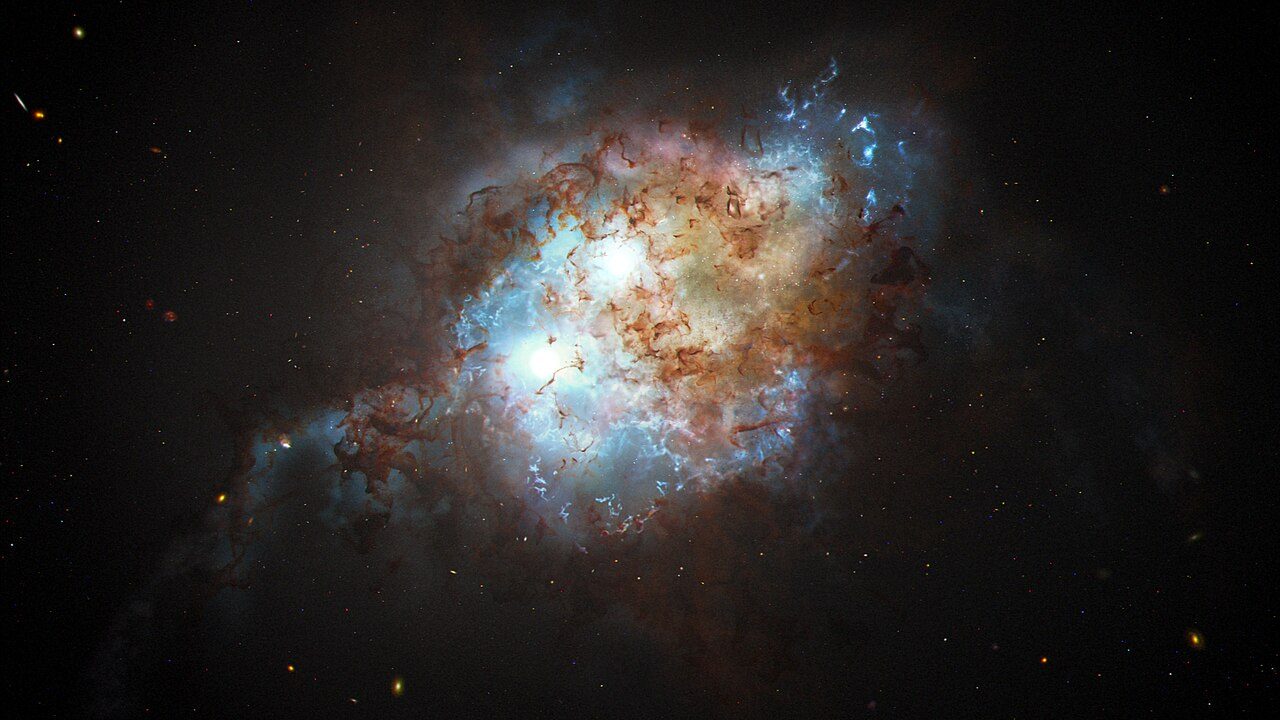
On Nov. 10, 2026, astronomers led by Silvia Onorato of NSF NOIRLab announced the most distant and earliest compact pair of quasars yet found. The system, catalogued J1602+4228AB and nicknamed Nāpōwawāʻenakaulua, is seen as it was about 900 million years after the Big Bang, when the universe was roughly a thirteenth of its present age. The results appear in The Astrophysical Journal Letters (DOI 10.3847/2041-8213/aeb11f).
A quasar is the glowing centre of a galaxy, lit up by gas and dust spiralling into a supermassive black hole. The two black holes here are estimated at about 1.5 billion and 400 million solar masses and sit roughly 18,100 light-years apart, about one-fifth the diameter of the Milky Way. NOIRLab describes it as the most compact pair found at cosmic dawn and the third quasar pair known from that era.
The pair was not the target of a search. It turned up when the team visually inspected data from Aether, a James Webb Space Telescope survey led by Emanuele Paolo Farina that covers about 200 early-universe quasars, roughly 43 percent of those known from the period. The Webb spectrograph data revealed a companion beside an already known quasar, and Gemini North on Maunakea then separated the two sources from the ground using its GNIRS instrument. Onorato said the sky was so clean and sharp that the data took only two nights.
The scientific tension is about time rather than existence. Space.com reports that current models need at least about a billion years for a black hole to feed and merge its way up to millions or billions of solar masses, yet Webb has repeatedly found quasar-powering black holes as early as about 400 million years after the Big Bang. Here two such objects coexist before the universe was a billion years old. Onorato's own assessment is blunt: there is no definitive theoretical explanation for how even a single one of these giant quasars exists so early.
It is also worth understanding why such pairs are scarce in catalogues. Galaxy mergers should be common, so close quasar pairs ought to be too. But the quasar phase is brief, distant pairs are faint, and two sources only a few thousand parsecs apart are hard to split into separate objects. That detection bias means three known pairs at cosmic dawn says little about how common they really are.
The team's interpretation is that the system could mark an extreme density peak in the early universe, where interactions between galaxies fed star formation and black hole growth together. NOIRLab calls it a laboratory for studying how the first massive galaxies and their central black holes assembled. This is a hypothesis from the researchers, not an established result.
One caveat remains open. The team used Gemini North's GMOS instrument to test whether the fainter quasar is merely a second image of the brighter one, produced by a foreground gravitational lens. Differences in the spectra favour a genuine physical pair, but the researchers say a lens model is still needed to rule lensing out definitively. Until then the pair is strongly supported rather than proven.
The name itself carries a note of context. It was created by the A Hua He Inoa programme at ʻImiloa Astronomy Center of Hawaiʻi and the University of Hawaiʻi, with Larry Kimura credited, and NOIRLab renders it as two celestial bodies of fathomless powerful darkness in the brilliance of heat reincarnating energy into the universe.
Source note: this report is based on the NOIRLab release distributed through EurekAlert and on Space.com's coverage. We have not read the full journal paper, and neither source gives the system's redshift, so we do not cite one. Technical values should be checked against the paper.
 프리즘코리아 편집국 > Alex Rowan