Webb 'Digital Twin' Method Pulls a Known Exoplanet Out of Starlight in Old Data
A Northwestern team's FLIP method, published in Nature, recovered the giant planet 51 Eridani b from archival Webb data by modeling and subtracting the telescope's own starlight glare.
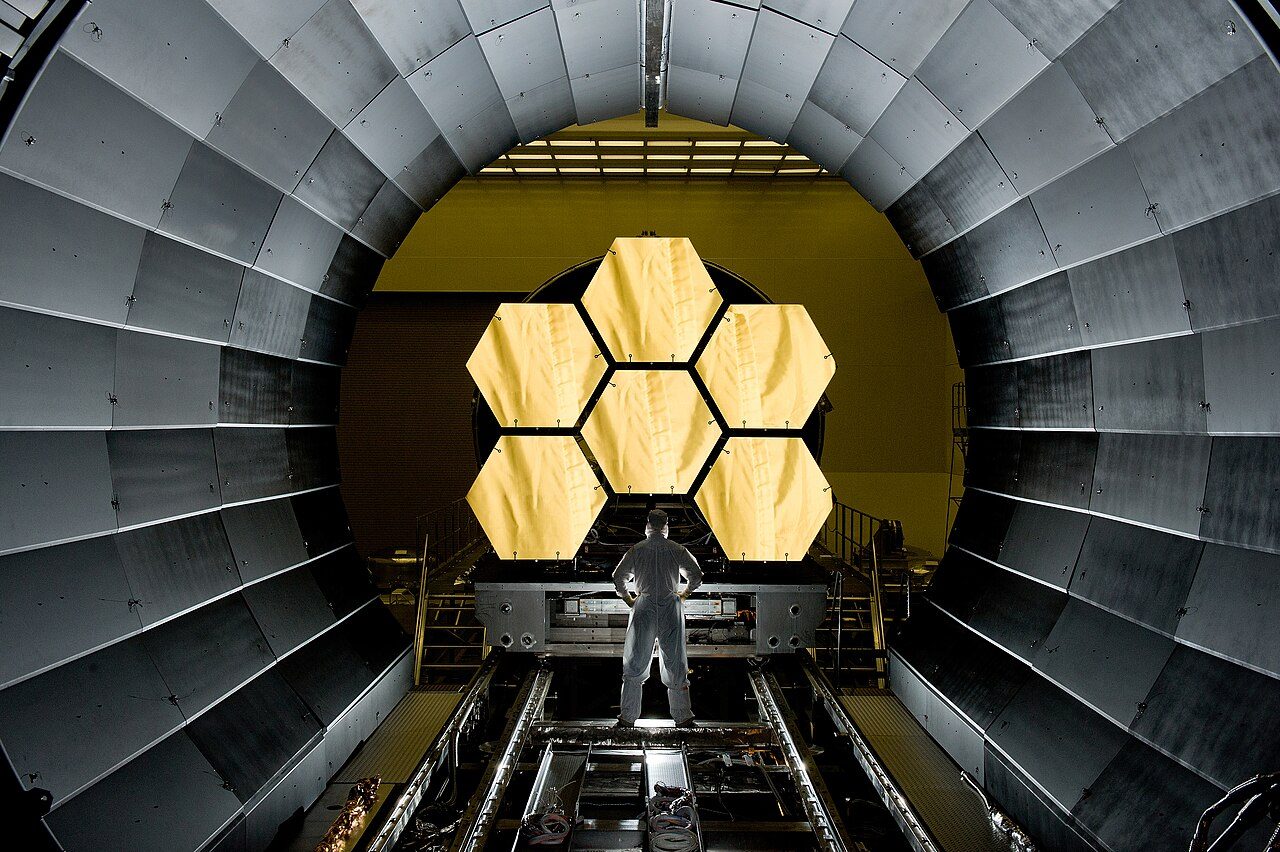
A Northwestern University team reported in Nature on Nov. 4, 2026, a way to dig faint planets out of James Webb Space Telescope images by modeling the telescope itself. The paper, titled "Imaging exoplanets below the telescope stability limit," was led by astronomy Ph.D. student Rodrigo Ferrer-Chavez and supervised by assistant professor Jason Wang, according to the university's release on EurekAlert.
The test case was 51 Eridani b, a gas giant about 11 times Jupiter's mass orbiting a star roughly 97 light-years away. Ground-based telescopes found it in 2015, but it had not shown up in earlier Webb observations because starlight overwhelmed it. Space.com notes that a coronagraph blocks some of the star's light but not all, and that small vibrations from Webb's cryocooler motors jostle the mirrors enough to scatter residual starlight that can hide a planet.
The method, called FLIP (Physics-based Learning for Imaging Planets), builds a "digital twin" of the telescope that simulates how starlight travels through the mirrors to the detectors. The team tuned millions of parameters describing tiny optical imperfections until the simulation reproduced the unwanted glare in real images, then subtracted that glare. The release says the optimization tools resemble those used to train AI models, but the researchers say they do not use AI to identify planets.
The team tested FLIP on existing Webb data for three stars: HIP 65426 and 51 Eridani, which have known planets, and TYC 5899, which has none. Sensitivity to faint planets improved by 2 to 15 times over conventional processing, and the method revealed 51 Eridani b in data collected about two years earlier; the release's figure caption reports a detection above 5 sigma. Wang said, "We showed that we can actually recover a planet that people previously couldn't see." The release adds that the planet absorbs carbon dioxide at 4.3 microns, which makes it fainter at that wavelength but could offer clues to its atmosphere.
The longer-term pitch is about future telescopes. The release says NASA's proposed Habitable Worlds Observatory, meant to image Earth-like planets, may need picometer-scale stability, and presents FLIP as a way to correct instability with computation rather than only engineering it away. The release frames that requirement as roughly 100 to 1,000 times more stable than Webb; that figure is the team's own framing and was not independently checked here.
Several cautions apply. The result rests on three stars and one recovered planet that was already known, so it is not a new discovery. Space.com notes the planet's appearance in the published images is a model-based prediction, not a direct photograph. The release also gives two figures for how much fainter planets are than their stars, a million times in one place and 100,000 times in another, and states the 15-times gain both as "up to" and as a 2-to-15 range. How FLIP performs on other targets, or with instruments whose behavior is harder to model, is not addressed in the sources, and any use for the Habitable Worlds Observatory remains an expectation rather than a demonstrated result.
 프리즘코리아 편집국 > Alex Rowan