Gaza floods expose a gap in winter readiness: tents counted, pumps and fuel missing
After the Board of Peace called Israel's response to Gaza's flooding "insufficient," the dispute turns on what reaches camps and whether local crews have the equipment to use it.
The Board of Peace, the body tasked with implementing the October 2025 US-brokered ceasefire between Israel and Hamas, said on 9 November 2026 that Israel needed to act immediately to help Gaza through the winter. In a statement reported by AFP, it said the situation "no longer represents simply a threat posed by the approaching winter, but an immediate humanitarian emergency." It acknowledged steps Israel had taken but called them "insufficient," and also urged Hamas to abide by its ceasefire commitments.
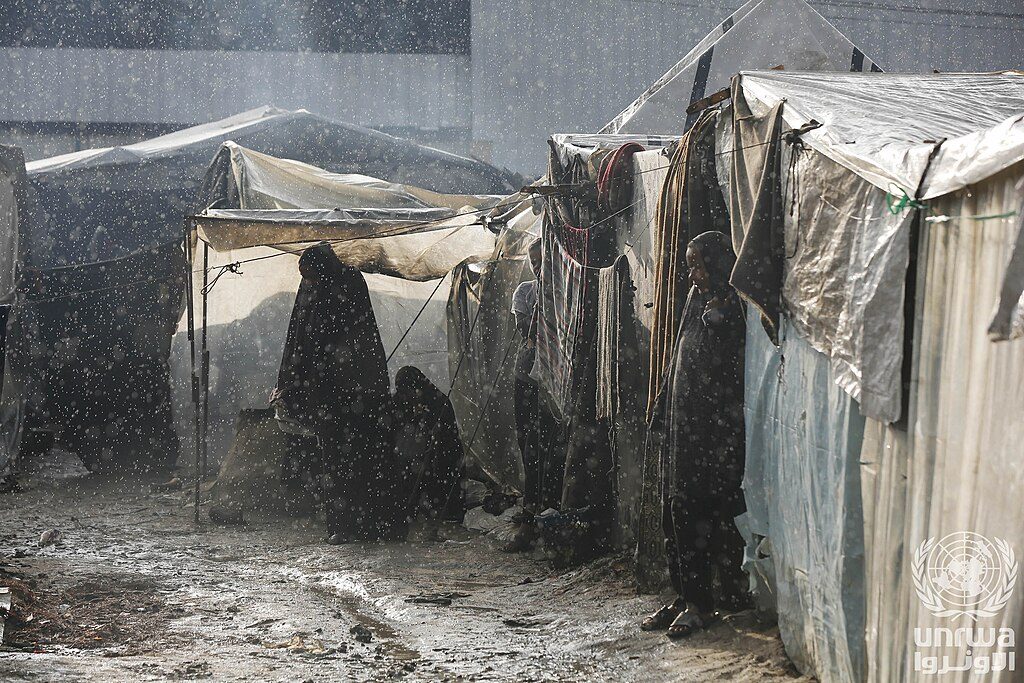
Much of the argument is being conducted in tent counts. Israel's military said shortly before the statement that more than 8,200 trucks had been allowed into Gaza, including 91,000 tents. The Hamas-run Gaza government media office said at least 70,000 tents flooded in a 12-hour period, according to Reuters on 7 November, and AFP later reported that two days of heavy rain swept away tens of thousands of tents, with at least five deaths according to Hamas-led authorities. The two sets of numbers measure different things: tents delivered over months do not show how many are still standing, how many replaced damaged ones, or how many families remain without shelter.
A less visible part of the story is the local capacity to respond once the water arrives. Reuters reported that municipal and civil defence officials said they could not cope with the storm because of fuel shortages and damaged equipment, and that hundreds of vehicles, including bulldozers and water pumps, were destroyed during the war. Civil defence received about 1,500 distress calls, and three abandoned houses collapsed without injuries. Those accounts come from Gaza officials and residents, and Reuters noted that Israel's aid-coordination agency COGAT did not immediately respond to the accusations.
COGAT's own account points at sanitation. In a statement the day before the Reuters report, it said it had stepped up efforts to improve sanitation across Gaza ahead of the expected rain, in coordination with international organisations, and that four additional vacuum trucks had entered through the International Committee of the Red Cross that week, joining eight brought in during the previous month. Those trucks support sewage pumping, waste removal and water and sewage repairs. Israel's foreign ministry took a different line on X on 8 November, saying Hamas "doesn't get to escape responsibility every time it rains" and should have invested in infrastructure instead of weapons.
The equipment question sits within a wider stall in reconstruction. The Week, citing a Guardian report, wrote in October that Israel had not allowed contractors, heavy machinery or construction materials into Gaza, freezing the first construction project awarded by the Board of Peace, a temporary outpost for international troops. Board officials describe that outpost as a prerequisite for later recovery work. The Week also reported aid groups saying items such as metal tent poles, engine oil and spare machine parts are classified by Israeli authorities as dual-use military equipment. Israeli officials and the military declined to comment on the contractor restrictions in that report, so the claim rests on secondhand reporting and has not been tested here against an Israeli response.
What the Board's statement adds is the source of the criticism. It comes from a mechanism built around a US-led plan, and it names Israel's response as inadequate while also pressing Hamas. Reuters notes that negotiators have still not agreed terms for Hamas to disarm or for Israel to withdraw, that Israel controls about two-thirds of the territory, and that most of Gaza's more than two million residents are displaced and live in tent camps. That backdrop means tents are only one input: shelters that hold up in rain also depend on materials, drainage, fuel and working machinery.
Several things remain unverified. The death toll and the number of flooded tents come from Hamas-linked authorities or secondary reports and have not been independently confirmed in the sources reviewed. The full text of the Board's statement was not available to this reporter, and no formal Israeli reply to it appeared in the coverage read. The practical test over the coming weeks is whether approvals for winterisation supplies, pumps and repair equipment speed up in ways that can be checked against what camps actually receive.
 프리즘코리아 편집국 > 森川結衣 · Yui Morikawa