Ebola in Congo passes 10,000 confirmed cases as Nigeria traces 53 contacts
ECDC's latest figures show the Bundibugyo outbreak in the DR Congo growing at a steady pace, while Nigeria's imported case is being followed through dozens of contacts.
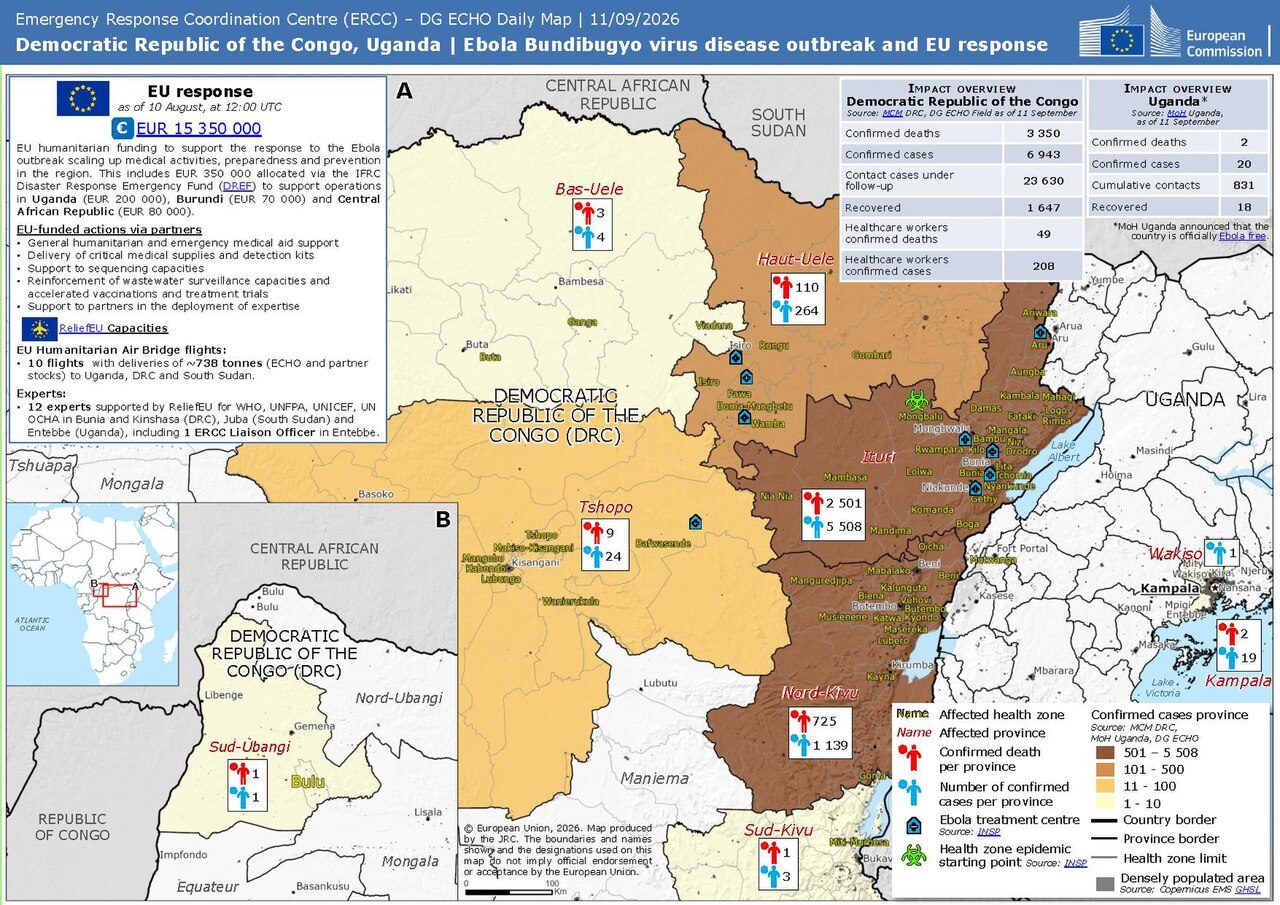
The Bundibugyo Ebola outbreak in the Democratic Republic of the Congo has passed 10,000 confirmed cases. The European Centre for Disease Prevention and Control (ECDC) reported on 30 October that, as of 29 October, the country had 10,274 confirmed cases and 4,992 related deaths, with data running up to 28 October. ECDC says community transmission is ongoing and that eight provinces are affected.
The ECDC's earlier entries allow a rough look at the pace. On 8 October it listed 8,728 confirmed cases and 4,205 related deaths. Over the 21 days to 29 October that is about 1,550 additional confirmed cases and roughly 790 additional deaths, or around 74 confirmed cases a day. Entries taken from different reporting dates carry delays and revisions, so this is an approximation and not an official rate.
Two readings are possible from the same numbers. Deaths equal close to half of confirmed cases (4,992 of 10,274), a ratio that is not a fatality rate because many cases are still unresolved and reporting lags. The steady daily increase also gives no sign yet of the outbreak slowing, though a few weeks of aggregate data cannot show whether the underlying trend is changing.
The virus has crossed borders. ECDC records that Kenya reported its first confirmed case, imported from the DR Congo, on 6 October. UN News, citing the World Health Organization (WHO), said nine cases had been reported in Kenya and one in the Netherlands, and that Nigeria was the fifth country to detect the virus since the DR Congo declared the outbreak in mid-May. A health worker in the DR Congo who tested positive on 29 September was medically evacuated to the Netherlands on 1 October.
Nigeria's case shows how much depends on contact tracing. According to UN News, a woman who had travelled from Uganda to Abuja began showing symptoms on 7 October, sought care at a private facility on 11 October, and was confirmed positive on 20 October. Al Jazeera quoted physician Ayoade Alakija saying 12 days passed between her falling ill and being tested, a gap that could have exposed others. Nigeria identified 44 contacts by 21 to 23 October, most of them health workers, and ECDC says the number was 53 by 26 October. ECDC reported on 27 October that she had been medically evacuated to Switzerland.
How she was infected is still being investigated. UN News reported that Uganda's own outbreak was declared over in late August, which makes the source a question for surveillance well beyond Nigeria. Until investigators answer it, it is unclear where monitoring needs to be strongest.
There are few medical tools to fall back on. Both UN News and Al Jazeera say there is no vaccine for Bundibugyo virus, and Al Jazeera adds that there is no specific treatment. That leaves early detection, isolation, infection control and contact follow-up as the main defences, which is the focus of WHO support in Nigeria. WHO has not recommended travel or trade restrictions on affected countries.
Africa CDC Director-General Jean Kaseya said the outbreak is no longer one country's fight and planned a meeting of health ministers the following week, according to Al Jazeera. This article is based on published reports and ECDC's published updates, and it does not include independent reporting from the affected areas. Case counts differ between sources and dates, so readers should check the current ECDC and WHO pages for the latest figures.
 프리즘코리아 편집국 > Adrian Cole