A coral rescue in the lab faces a different test on the reef
Stanford’s contact experiment shows a route to restoring symbionts in bleached fragments. NOAA’s restoration work illustrates why survival, habitat and reproduction remain separate tests before a laboratory rescue can become a reef intervention.
A bleached coral regaining its symbionts is an important biological result. Turning that recovery into a lasting reef intervention requires a different set of measurements. A Stanford-led study published on October 14 identifies a mechanism for helping already-bleached fragments recover, while leaving its performance in natural reef conditions unresolved.
The Science Advances paper studied small fragments of Pocillopora damicornis. Healthy fragments supplied symbionts to bleached fragments of the same genetic individual through tissue fusion. In its initial continuous-contact experiment, all five bleached recipients reached complete polyp recovery within eight weeks. The authors also observed additional growth at a later, 20-week assessment. These are stronger observations than a photograph showing a return of colour, but they remain outcomes for aquarium fragments.
The experimental environment matters to the next step. The authors report that their colonies came from aquarium suppliers, with original collection location and depth unavailable. Experiments and controls shared a tank maintained at 27.4 degrees Celsius, and feeding was probably greater than on natural reefs. The study explicitly leaves open how far recovery can spread across a colony and how consistently the process works across species, symbionts and colony shapes. Those limits make field testing essential; they do not negate the laboratory finding.
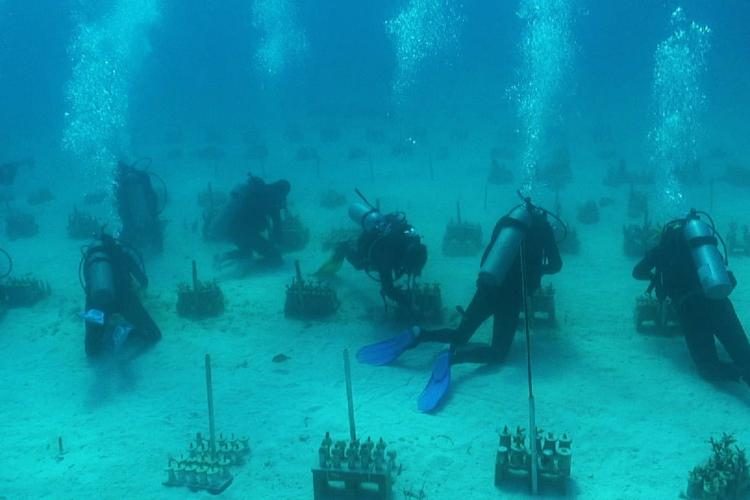
NOAA Fisheries’ work on elkhorn coral provides a separate example of what restoration programmes investigate after corals leave a nursery. Its management account describes controlled studies of survival and growth across habitats, predation, disease and the formation of branching thickets. Researchers also collect gametes and rear larvae to understand settlement and survival to adulthood. Elkhorn coral is not the species tested in the Stanford experiment, and these NOAA programmes are not trials of the new contact method. They show why fragment recovery and population recovery need different evidence.
A further distinction concerns the reef around the coral. NOAA’s restoration tutorial describes stabilising the seafloor, rebuilding communities of coral, fish and other organisms, and managing pests. It also identifies water quality as essential. Restoring symbionts within a fragment would not by itself demonstrate that these wider conditions had improved. For readers assessing restoration claims, the relevant question is therefore what was measured: recovery of polyps, survival after outplanting, reproduction, or recovery of an ecosystem.
The practical significance of the new study is a possible response after bleaching has occurred. Its findings justify investigating whether that response can work beyond controlled conditions. Evidence of field survival and broader ecological performance would be an additional result, not something already contained in the successful aquarium experiment. The accompanying NOAA archive photograph illustrates coral restoration work; it does not depict the Stanford study.
 프리즘코리아 편집국 > Nguyễn An