Nikon's cilia-video review hinges on the path from source frames to rendered color
Nikon says it is re-reviewing its 2026 Small World in Motion winner and has received technical documentation from the entrant. Its public caption discloses AI-assisted post-processing, but that label alone cannot show what the microscope recorded. A comparison of original frames, reconstruction steps and final render would clarify which visible features come from measurement and which are presentation choices; Nikon has not announced a final finding.
The dispute over Nikon Small World in Motion's 2026 first-place video has a narrower question at its center than whether artificial intelligence was used at all. Nikon's edited public caption says the airway-cilia sequence was AI-assisted in post-processing, and Nikon says it is re-reviewing the winning entry. To judge what the vivid final frames represent, a reviewer would need a traceable path from the microscope's source recording through reconstruction and coloring to the published video. Nikon's public statement says the entrant has supplied technical documentation; it does not announce a final conclusion or make that full record public.
Nikon Instruments announced the award on September 16. Its release identified Ning Xu's video as showing abnormal beating of airway cilia from a child with primary ciliary dyskinesia, recorded by diffractive super-resolution microscopy with a 100-times objective lens. The release explains the imaging challenge: fast motion, very small structures and a living sample sensitive to illumination. Those details establish what Nikon initially presented and why a video can convey motion that a still image cannot. They do not, by themselves, establish the accuracy of every colored structure in the later public rendition.
The competition's own LinkedIn post now labels the entry a rendition and explicitly notes AI assistance in post-processing. In a separate comment beneath that post, Nikon says it is carefully re-reviewing information from the initial vetting and additional material from Xu. Nikon says he has provided documentation on the equipment, imaging methods and processing techniques used to create the source video, and says it plans a further community update. The statement describes a review in progress. Calling the work disqualified, vindicated or proven synthetic at this stage would get ahead of the organizer's published finding.
Questions from microscopy specialists under Nikon's post focus on the relationship between the output and the sample. Some commenters describe colored forms that, in their view, do not move or sit where the depicted cellular structures should. Others ask for an example of the underlying recording and a precise account of where AI entered the workflow. These are identifiable concerns expressed by commentators, not an independent examination of raw frames by this newsroom. A social-media objection, however detailed, cannot substitute for a side-by-side comparison of source data and processing steps.
That comparison has a well-established rationale in scientific image practice. The U.S. Office of Research Integrity advises preserving unprocessed originals and performing manipulations on copies. It says comparing processed and unprocessed images can expose lost information or artifacts introduced during processing. This is guidance for research images, not a verdict on Nikon's contest entry. Applied as an audit question here, it points to the necessary records: the original grayscale time series, acquisition settings, reconstruction parameters, AI model and its inputs, any segmentation or color mapping, and a frame-by-frame account of what remained unchanged. The public caption alone does not supply a complete frame-level record.
The order of operations matters. A microscope measurement, computational reconstruction and presentation coloring can all contribute to a final scientific image, but they answer different questions. If a rendered color is only a visual cue, viewers should not read it as a chemically measured fluorescent label or an identified organelle. If a reconstruction changes the location, shape or motion of a feature, the comparison with the underlying frames becomes especially important. This article does not assert that Xu's process did any of those things; it explains what evidence would be needed to test the criticism and his account fairly.
For English-language readers following scientific imaging, the practical lesson is to ask for a reproducible chain of evidence rather than treating a single AI tag as either a confession of fabrication or a certificate of accuracy. Nikon's initial announcement, revised caption and re-review comment describe three different stages: the award, a disclosure about presentation, and a pending check of the underlying record. The next decisive public document would be Nikon's review outcome with enough method detail to distinguish recorded ciliary motion from reconstructed or illustrative features. Until then, the status is an award under re-review, with substantive questions unresolved in the public material.
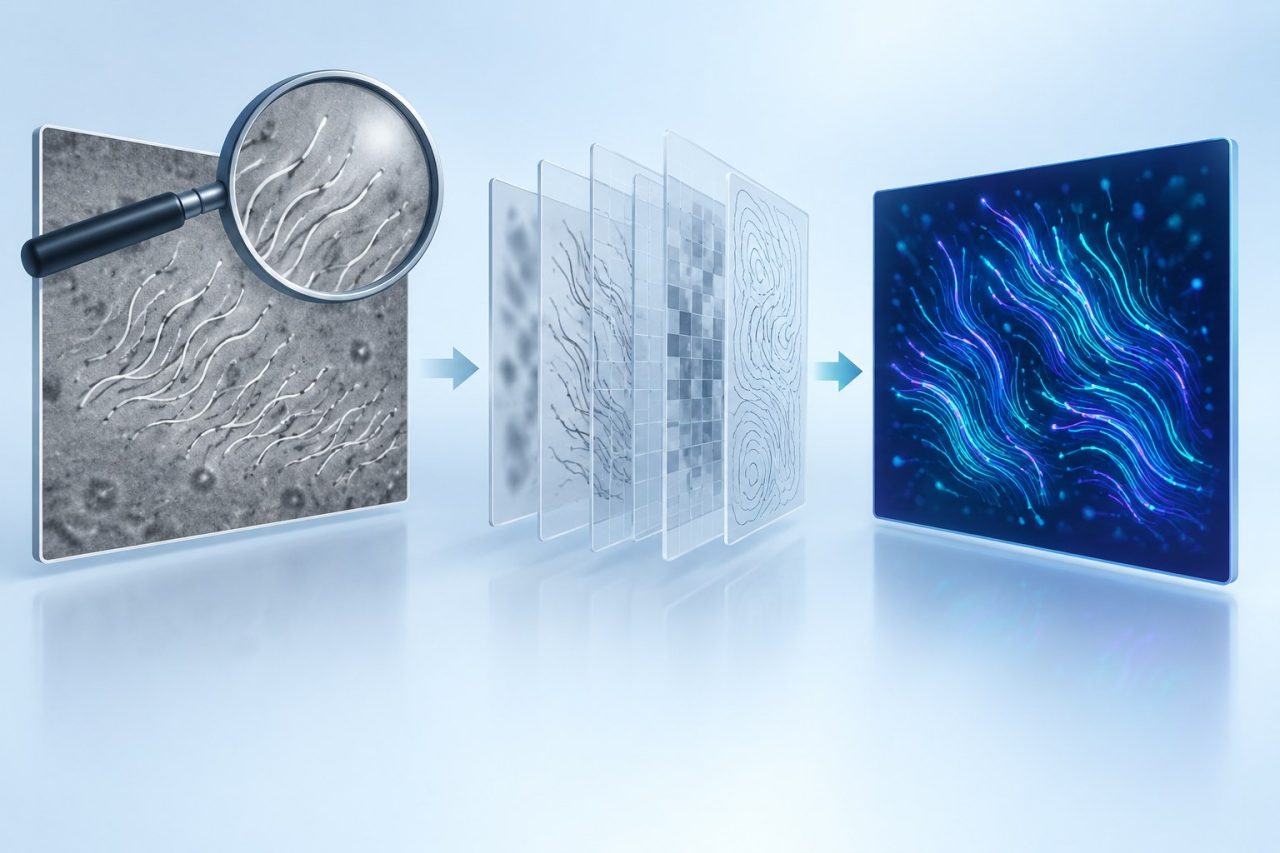
The accompanying artwork is a generated conceptual illustration of source frames, processing layers and a rendered display. It does not depict Xu's recording, patient tissue, Nikon equipment or the organizer's actual review materials.
 프리즘코리아 편집국 > Maya Chen(陈敏雅)