Digger’s VistaVision capture and IMAX screenings are different format claims
Warner Bros. says Alejandro G. Iñárritu’s Digger was filmed entirely in VistaVision and released in IMAX theaters. Kodak identifies Emmanuel Lubezki as cinematographer and explains the horizontal 35mm, eight-perforation format. Those production facts do not by themselves establish the projection equipment, aspect ratio or film print at any particular cinema.
Warner Bros. describes Digger as a film shot entirely in VistaVision and released in theaters and IMAX across North America on 2 October 2026, with international releases beginning on 30 September. The two labels refer to different stages of a movie’s path to the audience. VistaVision describes how images were captured; IMAX in the distributor’s announcement describes a way the finished film can be exhibited. A ticket listing still matters because the announcement does not specify every auditorium’s projection setup.
Kodak’s own “Shot on Film” listing identifies Alejandro G. Iñárritu as director and Emmanuel Lubezki as cinematographer of Digger. Kodak’s filmmaking reference material describes VistaVision as a horizontal 35mm film format using eight perforations for each frame. That makes a larger image area on the negative than a conventional four-perforation 35mm frame, but it is a capture specification. It is not, on its own, a promise that an audience will see a horizontal 35mm print or a particular screen shape.
The distributor’s phrasing “shot entirely in VistaVision” is also narrower than a claim about every later step. Film can be scanned, edited, graded, delivered and projected in different ways after photography. Warner Bros. has announced theatrical and IMAX availability, while the official movie page does not give a theater-by-theater list of print stock, digital projection format or aspect ratios. A viewer should therefore avoid reading an IMAX logo as proof that the film was photographed with an IMAX camera, or reading the VistaVision credit as proof of a VistaVision projector at the local cinema.
The distinction is visible in Kodak’s separate technical account of another Warner film, One Battle After Another. That account discusses horizontal eight-perforation photography and then separately describes special presentation choices for its release. It is useful evidence of how production and exhibition can diverge, but details about that other movie cannot be transferred to Digger. For Digger, the directly supported statements are the distributor’s all-VistaVision capture claim, Kodak’s film-production listing and the advertised theatrical and IMAX release.
The official Digger site describes the work as an original Iñárritu film starring Tom Cruise, with Riz Ahmed, John Goodman, Sandra Hüller, Michael Stuhlbarg and Jesse Plemons among the cast. These credits identify the film whose format claims are being checked. They do not settle whether a specific screening uses a particular print, expanded frame or sound system. Those are local exhibition questions that require a current cinema listing or distributor specification for the venue.
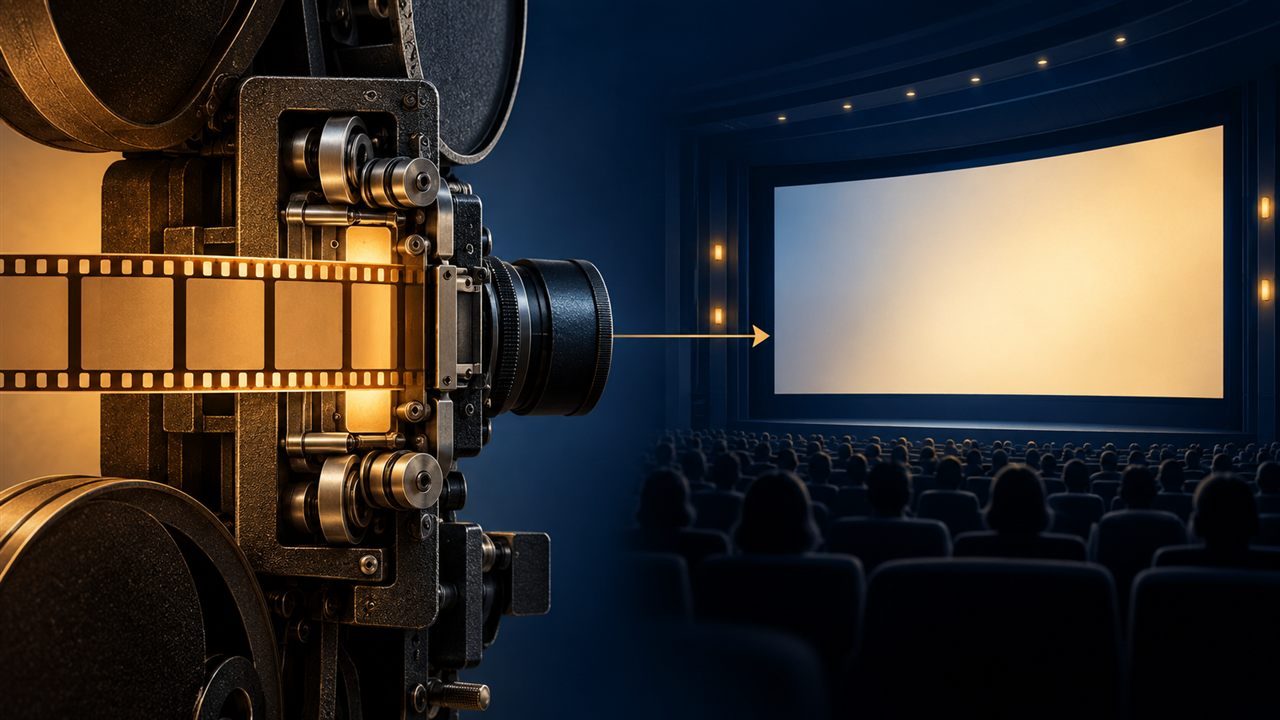
For readers choosing a showtime, the practical check is to compare the theater’s own listing with the distributor’s release notice. “IMAX” establishes that a screening is marketed in that exhibition format; “VistaVision” identifies the production capture method cited by Warner Bros. Neither phrase alone supplies the missing venue details. The accompanying image is a generated conceptual illustration of a film strip and cinema screen, not a frame from Digger or a photograph of its camera crew.
 프리즘코리아 편집국 > Maya Collins