ASUS's 128GB B70 Build: What the Spec Sheet Proves, and What It Borrows
ASUS pitches four UGen Arc Pro B70 cards as a 128GB local-AI rig. Checking the claims against two published reports shows which numbers are ASUS's own, which come from others, and what the build costs.
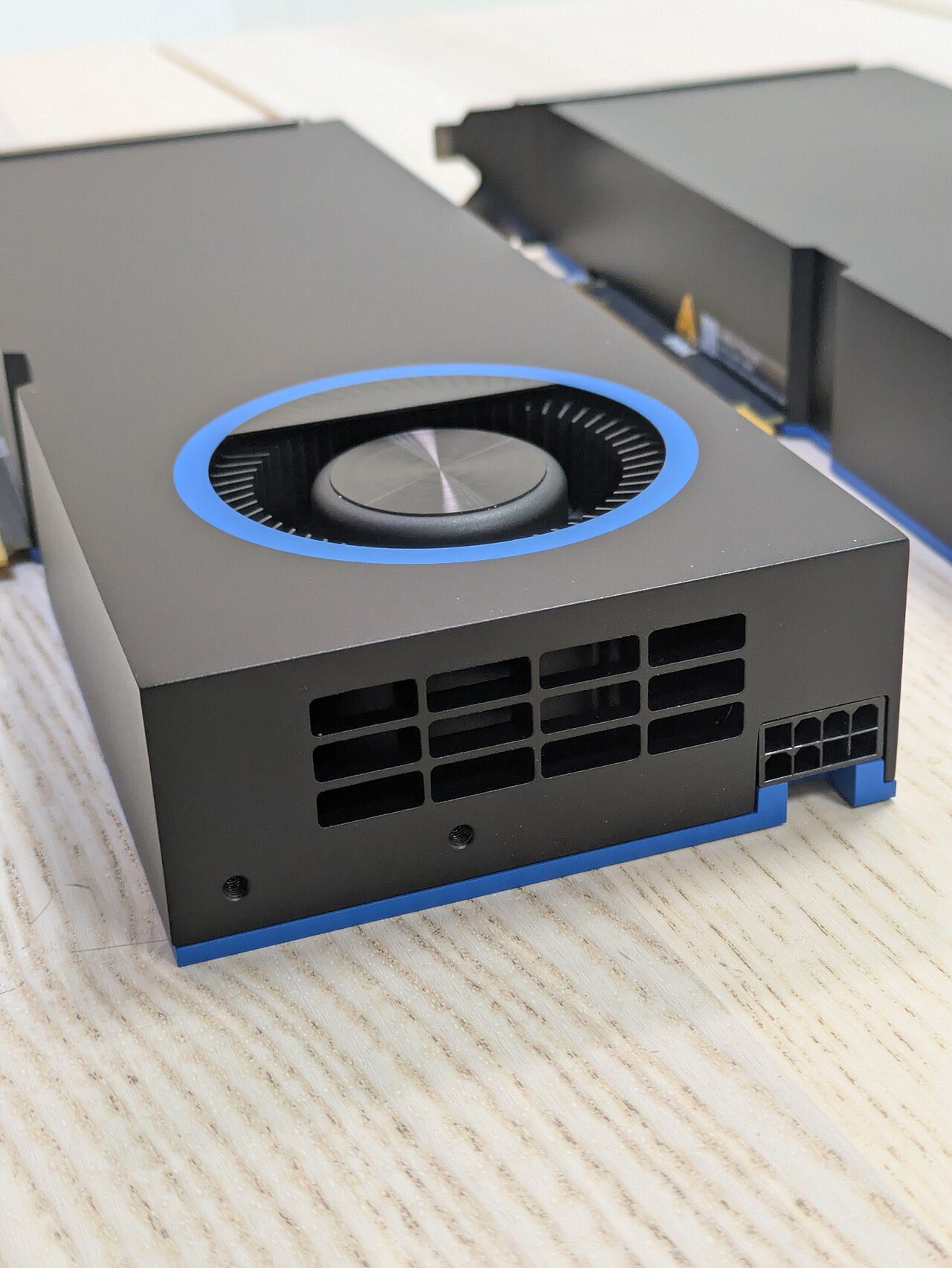
ASUS announced the UGen Arc Pro B70 32GB on October 23, a workstation card built on Intel's Arc Pro B70 silicon, and its main pitch for local AI is memory that adds up. According to Tbreak's October 29 report, one card gives 32GB of ECC GDDR6, two give 64GB and four give 128GB, which ASUS says is enough for models up to 120 billion parameters. A single card, the company says, handles most models under 27 billion parameters.
The card's memory spec is the same as Intel's: a 256-bit bus and up to 608GB/s of bandwidth, per both Tbreak and PC Games Hardware. The GPU is also the same, with 32 Xe2 cores, 256 XMX engines and up to 367 INT8 TOPS. What differs is the board. PC Games Hardware reports 310W for ASUS against 230W for Intel's reference card, a single 12V-2x6 connector instead of an 8-pin plug, and a recommended power supply of at least 750W.
That power gap compounds in the multi-card build the memory pitch depends on. PC Games Hardware puts four UGen cards at 1,240W in total, against 920W for four reference cards. Those figures cover only the cards, so a four-card workstation also needs room in its power budget for the CPU, drives and fans. Neither report gives a recommended supply for a four-card system, so that sizing is left to the buyer.
Price is the second constraint. PC Games Hardware reports an ASUS list price of 1,799 euros in Germany and Austria, and 1,799 Swiss francs in Switzerland. Four cards at that list price come to 7,196 euros before any other hardware, simple multiplication on the reported figure. The same outlet's October 26 Geizhals snapshot showed ASUS from 1,729 euros, Intel's own card from 1,689 euros and an ASRock model from 1,599 euros. Quoting Notebookcheck, Tbreak says Intel launched the B70 at $949 on March 25, while the cheapest new US listing on October 27 was $1,499.99.
Several performance numbers in the launch material are not ASUS measurements. Tbreak reports that ASUS's press release claims up to 128K tokens of context for Llama 3.1 8B on one card, while the product page lists about 93K at BF16 and credits Intel. The 43.4 tokens per second quoted for an 80-billion-parameter-class model on two cards comes, per the same report, from a community llama.cpp SYCL benchmark of Qwen3-Coder 80B, not from an ASUS lab test. PC Games Hardware adds that any gain from ASUS's higher power limit over Intel's card is unproven, since the maximum clock is the same 2,800MHz.
Software may matter as much as hardware. ASUS lists Intel LLM Scaler, vLLM XPU, llama.cpp, Ollama, OpenVINO and PyTorch XPU among supported tools, and Windows 11 and Linux as officially supported systems. Tbreak notes that StorageReview, testing Intel's reference cards rather than ASUS's, judged the hardware ready but the software stack not, calling LLM Scaler beta at best, with limited model coverage and some quantisation paths not yet working. ASUS also acknowledges that inference speed can fall by up to 90% when data spills into system memory.
What this reporting cannot say is how the card performs. PRISM did not test the hardware; this article compares two published reports and the manufacturer's claims. Tbreak says ASUS has not announced a price in its own announcement and gave no ship dates or specific countries, only that the card will be sold through authorised resellers worldwide. Anyone planning a four-card build should treat 128GB as the ceiling, not the guarantee, and check software support for their specific models before buying.
 프리즘코리아 편집국 > Daniel Reed