One homer, six runs: the White Sox's other paths to scoring in Houston
Chicago's 6–3 Wild Card opener included a hitless first-inning run, a two-run single after a hit batter and a seventh-inning wild pitch. The official sequence shows why home runs, hits and RBI totals describe different parts of the same offense.
The White Sox scored six runs in their September 29 Wild Card opener at Houston, but only one came from a home run. Chicago's 6–3 win offers a concrete example of how an offense builds runs through several kinds of events: walks, a hit batter, singles, an out that advances a runner and a wild pitch. MLB's official record places those contributions in five separate scoring innings.
The first run arrived before Chicago recorded a hit. Sam Antonacci walked to start the game. Kyle Teel grounded out to first baseman Christian Walker, whose subsequent throwing error allowed Antonacci to advance to third. Miguel Vargas walked, then Munetaka Murakami's sacrifice fly to right brought Antonacci home. A sacrifice fly records an out and an RBI while allowing a runner to score; the batter does not receive a hit.
Houston escaped that inning at 1–0 even though Chicago drew three walks. Andrew Benintendi also walked before Tristan Peters struck out. That ending is a useful limit on the story: reaching base created opportunities, but every walk did not become a run. The official runner record classifies the opening score as unearned, which is a pitching-accounting designation rather than a deduction from Chicago's actual total.
The second inning began with singles by Braden Montgomery and Chase Meidroth. Colson Montgomery was hit by a pitch, filling the bases without using an out. Antonacci's single then scored Braden Montgomery and Meidroth for a 3–0 lead. Teel followed with another single, but Houston stopped the attack: Vargas grounded into a forceout at home, and Murakami and Benintendi struck out. Four singles and a hit batter produced two runs, with further runners left unconverted.
Colson Montgomery supplied Chicago's lone homer in the fourth, a solo shot that made it 4–0. The next run followed another route. Murakami opened the fifth with a walk; singles by Peters and Braden Montgomery moved him to third, and Meidroth's infield single brought him home. Colson Montgomery then grounded into an inning-ending double play. Murakami's walk had become a run, while the inning's other runners did not score.
The seventh inning explains another apparent mismatch in the final statistics. Murakami and Randal Grichuk singled, and Peters' sacrifice bunt advanced both. Braden Montgomery struck out swinging on a wild pitch but reached first; Murakami scored from third during the play, putting Chicago ahead 6–2. MLB records the run with no RBI. A strikeout, a batter reaching base and a run scoring can therefore coexist in one completed plate appearance.
Chicago finished with 11 hits, four walks, two hit-by-pitches, one sacrifice fly and one sacrifice bunt. Its batting total lists five RBI beside six runs. The missing RBI belongs to the seventh-inning wild-pitch score, not an omitted run. The lone extra-base hit was Colson Montgomery's homer; the remaining ten hits were singles. The White Sox also grounded into three double plays, so their scoring was accompanied by several attacks that ended abruptly.
These are descriptions of what happened, not evidence that walks alone caused the victory or that a different pitch would have changed the winner. Chicago combined non-hit access to base with timely contact, while Houston's defense still prevented additional runs. The first-inning sacrifice fly and seventh-inning wild pitch show why counting hits or homers cannot reconstruct every scoring play.
The series is already complete: MLB's official schedule records Chicago's 7–3 win in the second game on September 30, giving the White Sox two victories. That later result does not alter the opener's six-run accounting. Reading the individual plays alongside the final totals preserves both the completed postseason outcome and the different ways the first win's runs were produced.
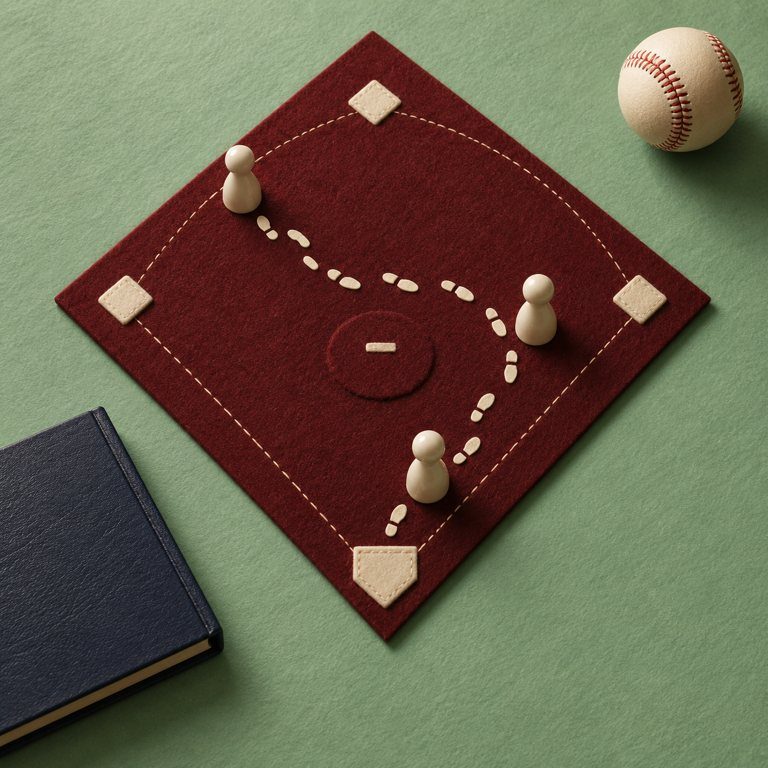
The accompanying AI-generated illustration uses a felt diamond, ceramic pawns and footprints to symbolize movement around the bases. It does not depict any actual player, play or equipment from the game.
 프리즘코리아 편집국 > Adrian Navarro